

Written by Mo Kahn on
July 22, 2026


You're probably staring at one of two screens right now. A checkout page that feels a little too vague, or your own pricing page that still says “DM for rates” because writing the actual number feels risky.
That hesitation costs creators sales every day. Buyers pause when they can't tell what they're paying for, whether they can use the work commercially, or what happens after the first purchase. Sellers hesitate because once a price is public, it feels permanent, easy to compare, and open to criticism.
For solo creators, side-hustlers, Etsy sellers, and indie authors, pricing transparency isn't a corporate compliance exercise. It's a trust tool. It tells people what they're buying, what they're allowed to do with it, and why your offer is worth the money.
A customer doesn't need to hate your price to leave. They just need to feel unsure about it.
That's the part many creators miss. Buyers can accept premium pricing when the offer is clear. They get nervous when the number appears detached from the outcome. If your listing says “custom art,” “digital pack,” or “AI-generated visuals” without spelling out usage rights, revisions, file delivery, or scope, people don't know how to judge value. They default to caution.
Transparent pricing reduces that friction. It helps a buyer answer three questions fast:
That's especially important in creative work because pricing often looks subjective from the outside. A book cover, merch design, avatar set, or printable bundle can't be evaluated the same way as a commodity product. You have to make the value legible.
Practical rule: If a buyer has to message you to understand the basics of your price, your offer is still carrying hidden cost in the form of time and uncertainty.
For creators selling digital goods or AI-assisted work, transparency also protects the relationship after purchase. Many disputes don't begin with bad intent. They begin with assumptions. A customer assumes commercial use is included. You assume personal use was obvious. Then the refund request lands.
If you sell AI-assisted visuals, it's smart to make licensing and resale language visible before checkout. That matters whether you're selling prompt-based art, printable downloads, or social content packs. If you need a practical example of how commercial considerations affect AI art sales, this guide on selling AI-generated art is worth reviewing.
Transparent pricing doesn't just filter out bargain hunters. It also helps serious buyers self-qualify.
A clear offer page tells the right customer, “This is for you, and this is how it works.” That shortens the decision cycle. It also improves your own positioning because you stop negotiating the fundamentals every time someone asks for a quote.
Use pricing transparency to make your business easier to trust, not cheaper to compare. In practice, that means showing the number, the scope, the limits, and the intended use case together. When you do that, price stops feeling arbitrary. It becomes part of a coherent offer.
In digital products, a visible number isn't enough. A price can be public and still be unclear.
That's because modern creative offers often include hidden layers. Access limits. credit systems. licensing restrictions. export quality. watermark rules. data use. upgrade prompts. A buyer may see “free,” “starter,” or “from $X,” yet still have no clean understanding of the actual cost.

For creators, pricing transparency now has to cover more than money. It also has to cover permission and limitation.
A transparent digital offer answers questions like these:
| Buyer question | What clear pricing should show |
|---|---|
| Can I use this commercially? | Whether resale, merch, client work, or ads are allowed |
| Is free actually free? | Any daily caps, throttling, watermarks, or feature locks |
| What changes at the next tier? | Better quality, more exports, faster generation, or broader rights |
| What am I giving up besides money? | Data use, usage tracking, waiting time, or reduced control |
If you don't explain those variables, the buyer still has to do detective work. That isn't transparency. It's outsourced confusion.
The biggest blind spot in digital commerce is the Free Tier Transparency Paradox. A 2024 study on digital transparency and user trust found that 68% of consumers feel misled by “free” digital services that later impose hidden usage limits, yet only 12% of free-tier AI tools disclose their data-use policies or credit decay rates upfront.
That gap matters for side-hustlers. If you're using a free tool to create Etsy products, character art, promo images, or social assets, the true cost may show up later as blocked exports, degraded quality, unclear rights, or forced upgrades. None of those costs look like a line item on a pricing page, but buyers and sellers still pay them.
Free only feels honest when the limits are obvious before the user invests time into the tool.
That's the updated definition worth using: pricing transparency means showing the monetary cost, the operating limits, and the legal or practical permissions attached to the purchase. In digital business, the hidden part usually isn't the price itself. It's the condition attached to the price.
Creators often treat open pricing as a moral issue. It is instead a strategy issue.
Publishing clear prices can improve trust fast. It can also expose weak packaging, vague value, or prices you haven't earned yet. That doesn't mean you should hide them. It means you should understand what open pricing solves, and what it doesn't.
Near the start of the decision process, this visual helps frame the trade-off.
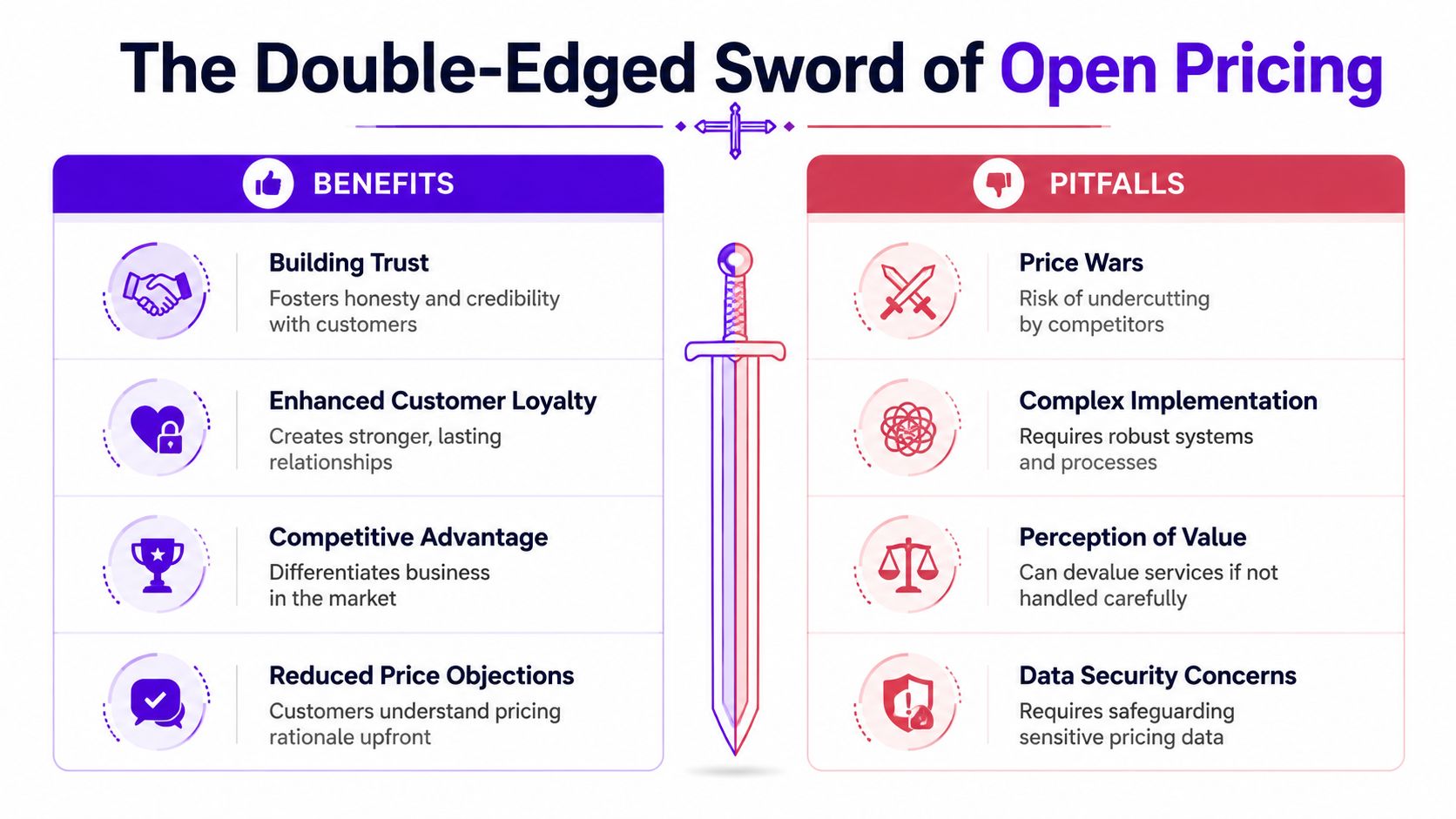
Open pricing removes suspicion. A buyer doesn't have to wonder whether you charge different people different amounts, or whether the final total will rise after they're already invested in the conversation.
That clarity creates a few practical advantages:
Open pricing can also change behavior in measurable ways, though not always in one direction. In healthcare, analysis of transparency systems and market effects found that average total payments for shoppable services decreased by 1.6% in some cases, while providing provider charge information led to a small overall increase in billed charges of 0.75% in some markets.
That tension is useful for creators. Transparency can help buyers choose better-value options. It can also harden market benchmarks and make some sellers more comfortable charging more when their reputation is stronger.
A short explainer on pricing psychology and disclosure can help you think through that balance:
The downside is real. When you show your price openly, competitors can undercut you. Buyers can anchor on your current number and resist later increases. A simple-looking offer can also appear overpriced if you haven't explained what's included.
The risk isn't transparency itself. The risk is publishing a bare number without the context that justifies it.
Common failure points look like this:
If you're going to be transparent, be complete. Open pricing works best when the number sits beside scope, usage, support, and limitations. Otherwise you've only made comparison easier. You haven't made trust easier.
Most creators don't operate under formal price disclosure laws. That doesn't mean the logic behind transparent pricing is irrelevant.
Consumer expectations are moving in one direction. People want fewer surprises, cleaner comparisons, and plain-language terms. Regulated industries show what happens when markets become too opaque for buyers to deal with on their own.
A strong example comes from healthcare. As of January 1, 2021, the United States required hospitals to publicly disclose standard charges online in machine-readable and consumer-friendly formats under the federal hospital price transparency rule from CMS. Yet compliance remained low, with studies showing rates between 13% and 49%, according to the CMS overview of hospital price transparency requirements.
That matters for one reason. Even under a federal mandate, organizations resisted clear pricing when disclosure challenged old habits, internal systems, or negotiating power.
Creators face a smaller version of the same problem. Many solo businesses keep pricing vague because custom work varies, platform fees change, or licensing is messy. Those are real complications. They aren't a good reason to leave buyers guessing.
You don't need hospital-style disclosure infrastructure. You do need buyer-first clarity.
Start by borrowing the principle, not the regulation:
If you create with AI tools, comparison becomes even more important because output quality, style control, and rights can vary widely across platforms. Reviewing an AI image generator comparison can help sharpen what buyers need to see before they commit.
Buyers rarely ask for perfect certainty. They ask for enough clarity to make a fair decision.
That's the true standard for fair pricing in a creative business. Not legal perfection. Honest disclosure of what affects the purchase.
For solo creators, the hardest part of pricing usually isn't choosing a number. It's deciding what the number includes.
That's why generic advice falls apart fast in AI-assisted work. A digital product can look simple on the front end and still carry major hidden variables underneath. If you sell a downloadable art pack, a custom character set, or print-ready graphics, your buyer isn't only purchasing the file. They're purchasing usage rights, convenience, quality, and predictability.
One of the biggest transparency problems in AI visuals is hidden production cost. In the 2026 benchmark on AI image generation costs, a single image can range from $0.005 to $0.20, creating a 35x cost spread due to variables like quality tiers. For a creator, that means “per image” pricing can be misleading if the underlying model quality changes from one job to the next.
That matters in two directions. If you're buying from a platform, you may not know whether a “free” or bundled image used a low-cost model or a premium one. If you're selling AI-assisted creative work, your own margin and delivery promise can shift based on the model tier you choose.
The second blind spot is rights ambiguity. A cheap image isn't cheap if the customer later discovers they can't use it on product packaging, merch, client campaigns, or Etsy listings. For indie authors and side-hustlers, rights transparency is part of pricing transparency.
A practical way to think about your listing is this: the buyer should understand cost, output, and permitted use without opening a second tab. If they still need your FAQ, terms page, and support inbox to decode the offer, the pricing page isn't doing its job.
If you're building products for marketplaces, this guide on selling digital downloads on Etsy is a useful reference point for how expectations differ between personal and commercial buyers.
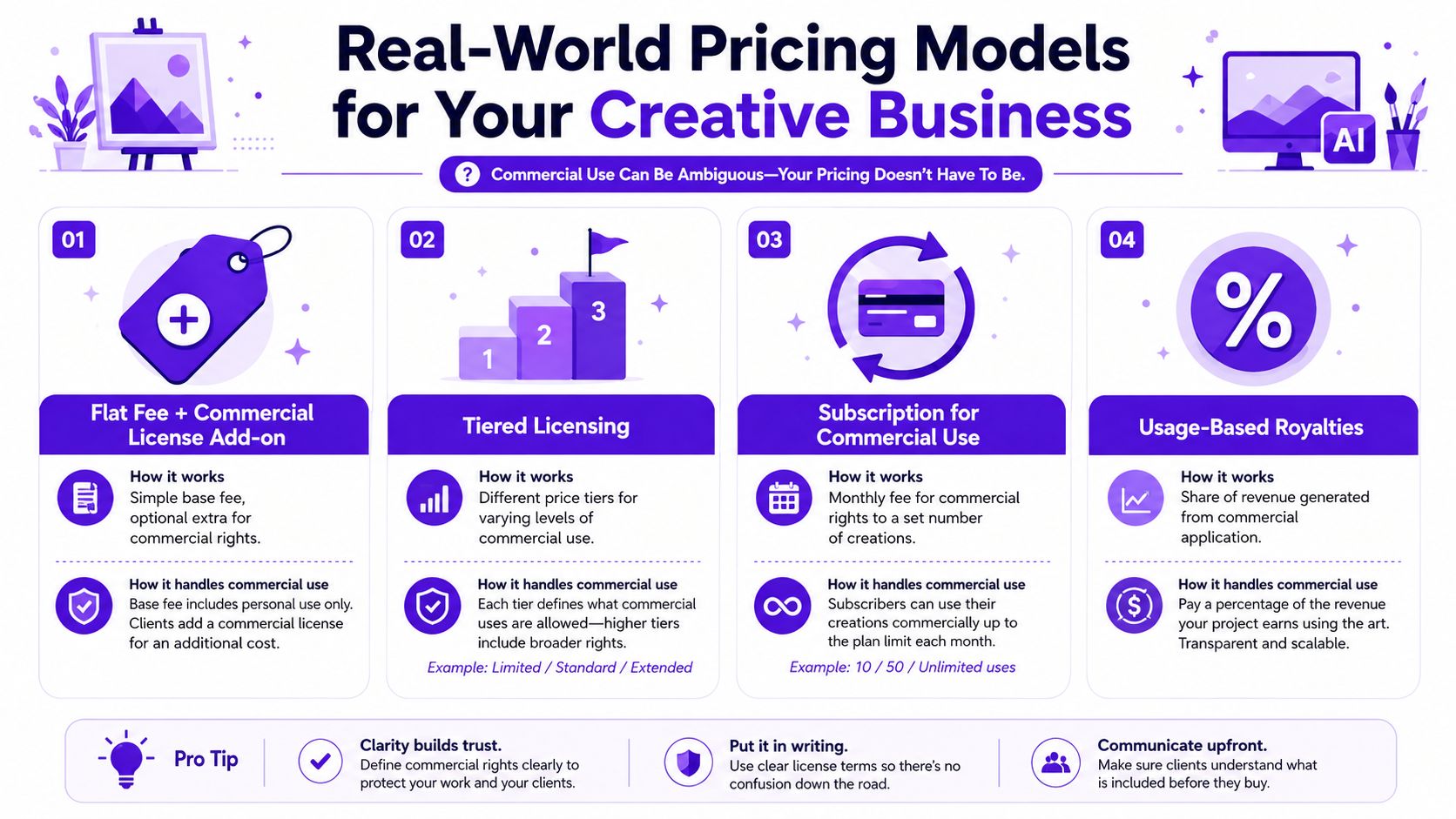
Different offers need different structures. These four are usually easier to explain and easier to defend.
| Model | Best for | Transparency strength | Main caution |
|---|---|---|---|
| Flat fee plus commercial add-on | Templates, illustrations, one-off downloads | Buyers can see the base price and the rights upgrade separately | Keep the commercial terms short and specific |
| Tiered licensing | Book covers, merch art, brand assets | Lets buyers choose by use case, not just budget | Tiers need plain-language distinctions |
| Subscription for commercial use | Ongoing content creators, marketers, shops | Predictable access and rights under one recurring plan | You need clear limits on volume and scope |
| Usage-based royalties | Collaborative products, co-branded assets | Aligns your upside with the buyer's performance | Harder to administer for small shops |
Here's where many creators get tripped up. They choose a pricing model that fits their workflow, but they explain it from their own perspective instead of the customer's. “Includes standard license” means little to a buyer. “Use on one book cover, not on resale merch” is much clearer.
A transparent pricing model doesn't just protect your business. It reduces buyer regret because the permission structure is visible before checkout.
When in doubt, simplify the offer around the buyer's intended use. That's the version they're trying to purchase anyway.
You don't need a massive pricing overhaul. You need fewer unanswered questions.
The fastest improvement comes from auditing your current offer the way a cautious customer sees it. Strip away what you know internally and look only at what the page communicates. If a buyer lands cold from TikTok, Etsy, Pinterest, or a Google search, can they tell what they'll get and whether they can use it the way they want?

Run this check on every product page, commission page, and service package.
List the visible price
If the buyer has to inquire just to learn the base cost, ask whether the offer is truly custom or whether you're hiding a standard range that could be public.
List the deliverables
Name the files, formats, quantity, and what counts as final delivery.
List the limits
State revisions, turnaround expectations, watermark rules, download caps, or any access limits.
List the rights
Make personal use, commercial use, resale, client transfer, and attribution rules easy to see.
List the payment terms
Clarify whether the customer pays once, subscribes, or purchases upgrades later.
A good benchmark for threshold clarity comes from subscription products that show clean package boundaries. A pricing snapshot of starryai plans lists a Pro plan at $11.99/month and an Unlimited plan at $37.99/month, giving users straightforward monthly and annual reference points to compare.
Most pricing pages improve when you replace sales language with decision language.
Use a simple structure like this:
Don't cram every exception into the product description. Put the key buying terms near the price, then support them with a short FAQ. Buyers shouldn't have to read your entire policy stack to feel safe enough to purchase.
Use plain language. The goal is confidence, not cleverness.
“This package includes the final files listed above, one round of revisions, and the usage rights shown on this page. If you need commercial or client-use rights beyond that scope, choose the upgraded license before checkout.”
For a rate increase:
“My pricing has been updated to reflect the time, production quality, and licensing support included in each order. Existing terms stay the same for current bookings confirmed before the change.”
For a price inquiry when the work is custom:
“Projects vary based on scope and usage, so I price them from the intended outcome rather than a flat template. Share the format, where the work will be used, and whether you need commercial rights, and I'll recommend the closest-fit package.”
Good pricing transparency doesn't mean giving away every internal detail. It means revealing the details a fair-minded buyer needs in order to choose without anxiety.
If you want a simpler way to create visuals without getting lost in vague pricing and unclear rights, explore starryai. It's built for creators who need fast image generation for social content, character concepts, and digital products without turning the creative process into a pricing puzzle.


.svg)