

Written by Mo Kahn on
September 18, 2026


Have you ever typed a dramatic phrase into an image generator, received a safety block, and wondered whether the system misunderstood your creative intent? A search for “heads blown off” may look like an interest in graphic violence, but the wording often creates a deeper problem: English uses related forms of “blow off” for completely different ideas, from releasing pressure to ignoring a message.
A creator might want a horror poster, an intense action scene, or a surreal transformation. The platform sees language associated with extreme injury and has to respond cautiously. That response can feel frustrating, especially when the creator's real goal is atmosphere rather than gore.
This guide separates the language from the imagery. It explains the phrase's meanings, why safety systems react to explicit violent wording, how historical and forensic language differs from everyday slang, and how to preserve dramatic impact with stylized alternatives in starryai. The aim isn't to punish imagination. It's to help you translate a risky phrase into a clearer visual brief that protects audiences while giving the image a stronger creative direction.
A creator opens an AI image generator with a clear idea: a character caught in a violent-looking supernatural blast, surrounded by sparks, smoke, and fractured light. They type a short prompt using the phrase “heads blown off.” The generator blocks it.
That moment can feel disproportionate. The creator may not want anatomy, blood, or realistic injury. They may be thinking about a comic-book impact, a surreal poster, or a music-video frame. Yet the wording describes a form of graphic harm directly, so a safety system may treat the request as high risk before it can infer a gentler artistic intention.
The important distinction is between creative intensity and graphic depiction. A scene can communicate danger through a character's silhouette, a burst of light, a collapsing environment, or a stunned reaction. It doesn't need to show bodily destruction. In fact, withholding the explicit event often gives the audience more room to imagine what happened.
Practical rule: Describe the emotion, composition, lighting, and aftermath you want. Don't use graphic injury as shorthand for intensity.
For starryai users, this distinction makes prompt writing more useful. Instead of asking for an explicit violent result, describe a cinematic freeze-frame, a fractured shadow, a supernatural energy burst, or a character disappearing behind smoke. The system receives a safer and more precise brief, while the creator retains control over mood and visual impact.
The phrase also deserves language-focused attention. Dictionary and slang references record several unrelated meanings for “blow off,” and “blow someone's head off” is separately understood as a phrase meaning to shoot someone in the head, as documented by English Reference's phrase entry. That combination makes the wording unusually easy to misread.
A calm workflow helps. First identify the intended meaning. Then separate the visual goal from the harmful wording. Finally, replace the risky description with effects the viewer can recognize without seeing graphic gore.
Start with the smaller phrase, “blow off.” It has several unrelated meanings, and context determines which one a reader hears.
The first meaning involves releasing pressure. Someone can “blow off steam” after a stressful day. The image is a pressure valve opening, not an act of violence. The phrase describes emotional release through conversation, exercise, music, or another outlet.
The second meaning involves ignoring or dismissing someone. If a person blows off a text, they ignore it. If they blow off plans, they fail to take them seriously or don't show up. The mental picture is a phone with an unanswered message, not an explosion.
The third meaning is literal violence, especially in the expression “blow someone's head off.” English reference material records that expression as meaning to shoot someone in the head, which explains why a platform may interpret “heads blown off” as an explicit violent request rather than a harmless idiom.
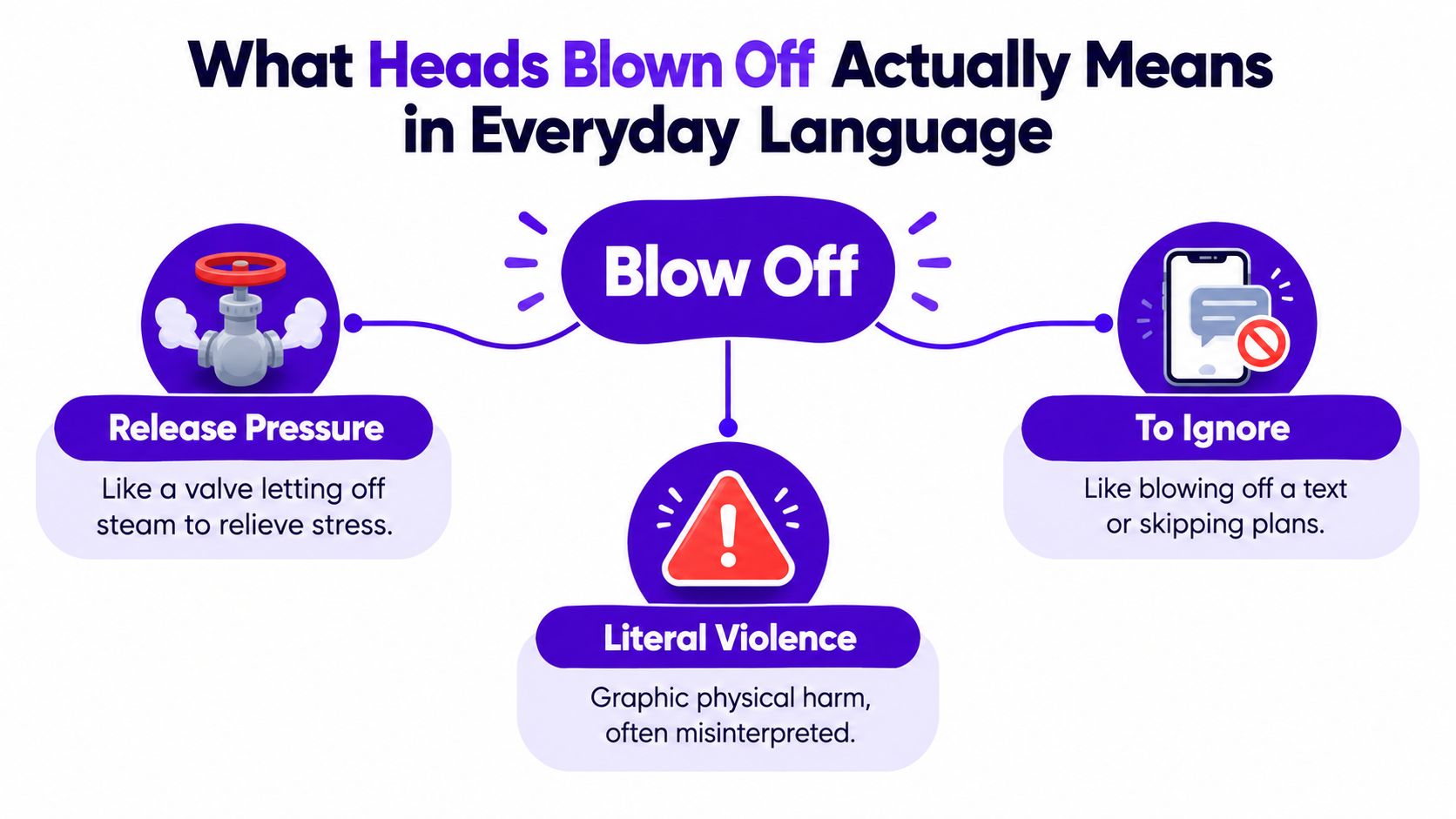
Longman's dictionary entry for “blow off” reflects this broader disambiguation problem. Related slang references also record nonviolent and sexual meanings, so the same surface wording can lead readers in sharply different directions. Regional English matters too. A phrase that sounds casual in one community may sound threatening or graphic in another.
Before writing a prompt, ask three questions:
The third option needs extra care because colloquial language and forensic language aren't the same. A technical discussion of injury may distinguish different mechanisms and evidence patterns, while everyday speech compresses them into a dramatic phrase. Readers seeking background on injury interpretation can consult this forensic analysis of blunt injuries, but creative prompts generally don't need medical terminology.
Platforms must also account for the most harmful plausible interpretation. A human friend can ask, “Do you mean blow off steam?” An automated system often has less context, so explicit head-violence wording creates a predictable safety response.
AI safety systems work more like screening desks than like creative editors. They scan a prompt for signals of harmful intent, compare those signals with policy categories, and decide whether the request can proceed. When a phrase describes graphic head injury directly, the system may stop before image generation because the wording itself carries a strong violent meaning.
An airport analogy helps. Security staff don't wait until they know exactly why an object is in a bag before checking it. They respond to risk signals first, then use context where available. An AI classifier follows a similar logic. It can't assume that a graphic request is fictional, educational, ironic, or stylized when the same wording could request realistic harm.
Context detection helps distinguish “blow off steam” from a violent phrase, but context isn't perfect. Short prompts provide little information, and a phrase like “heads blown off” leaves no clear nonviolent signal. The system may therefore classify it more strictly than a longer prompt describing a fantasy poster, abstract energy, or an off-camera event.
The policy boundary is easier to understand when divided into three practical groups:
The safest creative response is to clarify intent through the image language itself. Specify stylized illustration, cinematic framing, non-graphic action, silhouette, smoke, debris, or reaction shot. Avoid adding “not graphic” after a detailed gore request, because the main semantic signal can still dominate classification.
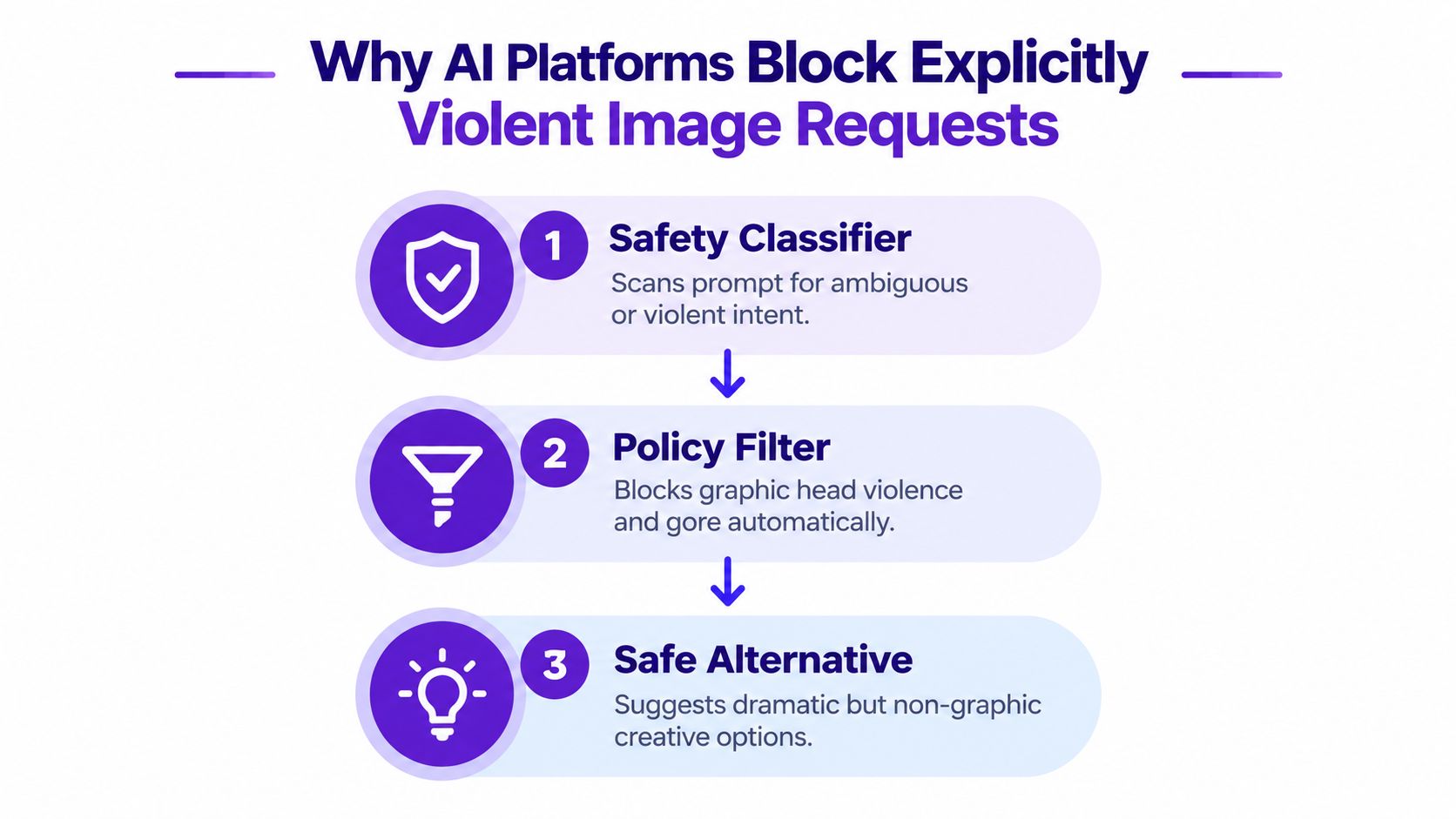
A platform's content policy gives creators the relevant boundary for prohibited extreme violence and excessive blood or gore. Policy literacy turns a block into useful feedback. The system isn't judging whether a creator is a bad person. It's identifying wording that could produce harmful material and redirecting the request toward a safer form.
For a visual example of how destructive force can be represented without explicit anatomy, consider this short video:
A strong replacement prompt doesn't hide the dramatic goal. It names it more accurately: “a shocked hero in a storm of violet light, shattered stone suspended in the air, intense backlighting, dynamic comic-book composition, no visible injury.” The scene remains urgent, but the viewer's attention goes to movement and emotion rather than gore.
Beheading isn't a new visual symbol. Britannica documents its use as an execution method in ancient Greece and Rome, while ritual decapitation associated with seppuku was practiced in Japan from the 15th through the 19th century. The guillotine became especially significant during the French Revolution, and estimates for executions during the Reign of Terror in 1792 to 1794 range from 16,000 to 40,000, while another summary places the figure at about 20,000, as discussed in Britannica's history of beheading.
France's last guillotine execution took place on 10 September 1977, when Hamida Djandoubi was executed. France abolished capital punishment in 1981, making decapitation part of a long historical arc that reached from ancient state systems into the modern era.
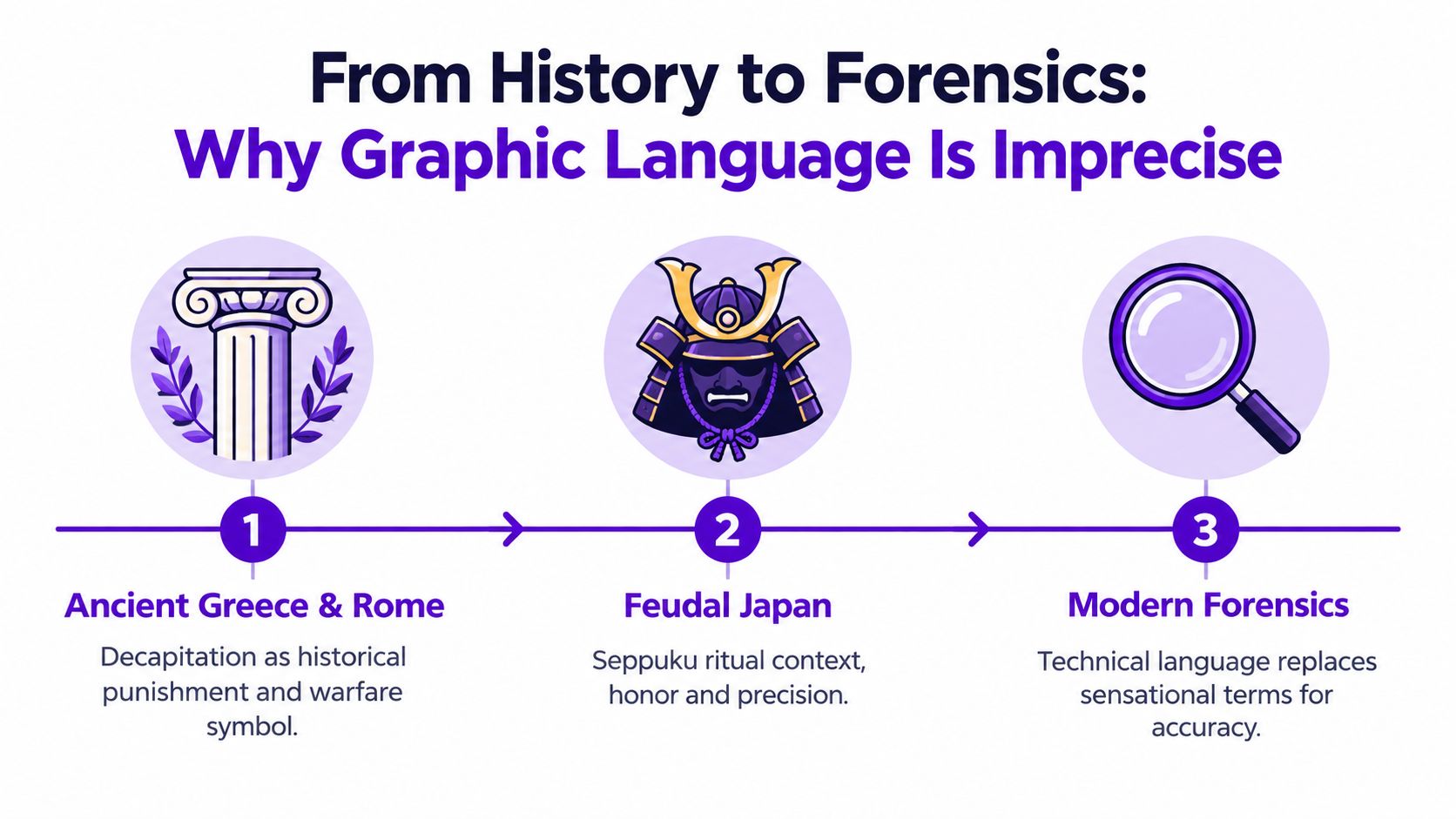
In forensic pathology, “head blown off” isn't a standard diagnosis. Technical categories include penetrating head injury, perforating head injury, and decapitation. A penetrating injury breaches the cranium without exiting, while a perforating injury passes through and exits. Complete separation of the head is classified separately as decapitation, according to the overview of penetrating head injury.
The visual outcome of a projectile also depends on variables such as bullet construction, velocity, distance, strike angle, yaw, fragmentation, and the way bone absorbs energy. A forensic discussion notes that bone impact and fragmentation can transfer energy internally, causing severe intracranial destruction without producing a large exit wound, while complete separation remains a different category, as outlined in this forensic analysis of missing exit wounds.
That technical variation exposes the weakness of the phrase for art direction. It doesn't specify composition, distance, camera angle, style, color, or narrative purpose. It only supplies a sensational outcome. A better prompt describes the intended symbol, such as a fractured helmet, a vanishing silhouette, a burst of energy behind the character, or a cutaway reaction shot.
Graphic wording is often a poor shortcut for visual intensity. Lighting, motion, framing, and character reaction can make a scene feel dangerous without showing graphic injury. The comparison below turns common goals into safer directions for starryai.
| Creative Goal | Avoid This Phrasing | Try This Stylized Approach in starryai |
|---|---|---|
| Explosive action for a game avatar | “Head blown off by an explosion” | “Futuristic warrior facing a blinding energy burst, flying dust and fragments, strong silhouette, dynamic perspective, non-graphic comic-book art” |
| A frightening book-cover moment | “Visible decapitation and gore” | “Dark figure beneath a broken halo, violent storm clouds, red emergency light, ominous negative space, implied danger, no visible injury” |
| A surreal transformation | “Head destroyed in a blast” | “Character dissolving into geometric shards and luminous smoke, dreamlike motion, abstract fantasy poster, elegant and non-graphic” |
| A short-form social visual | “Graphic violent impact” | “Freeze-frame action pose, neon shockwave, speed lines, dramatic rim lighting, high-contrast editorial illustration” |
| A horror tattoo concept | “Bloody severed head design” | “Haunting mask split by shadow, thorn shapes, occult geometry, distressed ink texture, symbolic horror, no gore” |
The last direction can inspire creators exploring haunting tattoo concepts with AI. Symbolic objects often carry more design value than explicit anatomy because they remain readable at poster, avatar, and thumbnail sizes.
Intensity comes from lighting, motion, and emotion, not gore.
For an indie author, off-camera implication can create a stronger cover mystery than a literal injury. For a tabletop gamer, a fractured aura or collapsing portal can communicate a character's power without making the avatar unusable for general audiences. A TikTok creator can use a shockwave, color inversion, or silhouette reveal to produce a dramatic transition that stays focused on transformation.
Prompt engineering becomes easier when you name the desired effect rather than the prohibited event. The prompt-engineering guide for beginners can help creators organize subject, setting, mood, style, and composition into a coherent brief.
A useful substitution formula is:
violent outcome → visual event + emotional reaction + cinematic treatment
For example, replace a graphic phrase with “a supernatural shockwave crosses the frame, the hero recoils in disbelief, smoke and purple light obscure the background, stylized graphic-novel composition.” The audience still understands that something powerful occurred, but the prompt gives the generator constructive visual instructions.
A reliable workflow starts with the image's purpose, not the risky phrase. Build the prompt in layers so each addition improves the composition instead of increasing harmful detail.

Begin with the subject. Write “masked vigilante,” “fantasy mage,” “retro astronaut,” or “surprised musician.” Keep the character's identity and pose clear before adding action.
Add the mood. Choose “ominous,” “euphoric,” “panicked,” “mysterious,” or “defiant.” Mood tells the generator how the viewer should read the scene.
Specify the visual event. Use “energy burst,” “shattered glass halo,” “expanding shockwave,” “swirling smoke,” “falling sparks,” or “fractured light.” These terms create movement without requesting bodily damage.
Finish with treatment. Add “cinematic rim lighting,” “graphic-novel ink,” “vintage pulp poster,” “surreal editorial illustration,” or “neon cyberpunk palette.” Treatment gives the image a defined aesthetic.
A compact prompt might read: “masked vigilante on a rooftop, defiant expression, expanding violet shockwave behind the figure, rain and sparks, dramatic rim lighting, graphic-novel illustration, non-graphic action.” This structure is more informative than a single violent phrase.
Use negative prompts to remove unwanted visual details, such as gore, blood, exposed anatomy, dismemberment, realistic injury, and graphic wounds. Keep the positive prompt focused on what should appear. Repeating prohibited terms, even to negate them, can create unnecessary ambiguity, so test a clean version first.
Style presets can guide the same concept toward comic art, poster design, dark fantasy, or animation. If a selfie is the starting point, the Edit tool can help turn the portrait into a dramatic character image through costume, lighting, background, and atmosphere rather than bodily transformation.
For fire-related scenes, creators can study safer methods in this guide to setting an image on fire, then apply the same principle to shockwaves and destruction: show the environment responding to force while keeping people intact and the frame non-graphic.
Test one change at a time. If the image feels flat, increase contrast, alter the camera angle, add motion lines, or place the brightest effect behind the subject. If moderation blocks the result, remove the violent outcome entirely and retain the atmosphere, silhouette, and reaction.
The phrase “heads blown off” combines a literal violent reading with a broader language problem. Clear wording helps distinguish pressure release, social dismissal, slang, and graphic harm. Policy awareness explains why an automated system may stop the literal interpretation. Creative technique supplies the replacement.
Before generating, run a quick review:
Responsible art direction isn't a reduction in ambition. A silhouette can create mystery. A burst of light can suggest overwhelming force. A character's posture can communicate shock more effectively than explicit anatomy. For cover experiments, a resource such as the Vocuno cover artwork tool can also support a broader focus on composition, typography space, and symbolic imagery.
Try three controlled experiments in starryai: an action silhouette with a bright backlight, an energy burst framed as a comic-panel impact, and a vintage poster showing an altered environment after an unseen event. Keep the character's reaction visible, keep graphic injury out of the prompt, and compare which version tells the strongest story.
The practical lesson is simple. Don't ask a risky phrase to carry your entire creative direction. Give the generator the atmosphere, movement, symbolism, and emotion that make the scene memorable.
starryai turns text prompts, selfies, and emojis into visual artwork you can refine for characters, covers, avatars, and social posts. Visit starryai to test a non-graphic shockwave, silhouette, or vintage poster concept and create dramatic imagery with clearer language and safer boundaries.


.svg)