

Written by Mo Kahn on


You're choosing an image for a TikTok cover, a sticker listing, or a seasonal post, and every flower looks a little too familiar. Then a close-up catches your attention: golden petals surround a dark center that seems to stare straight back. It's a flower, but it almost reads as a character.
That's the appeal of a flower with eyes. Real blooms offer dark discs, face-like blotches, concentric rings, and luminous throats that you can translate into expressive AI artwork without immediately adding human eyeballs.
The useful distinction is botanical pattern versus deliberate fantasy. A contrasting flower center can suggest an eye to people, but that doesn't automatically establish what the marking does for a pollinator.
These botanical references give you a more specific starting point than a generic surreal-flower prompt. Each comes with a starryai-ready prompt, style tags, and a social use case, plus practical adjustments for the places where anatomy, contrast, or composition can break down.
Black-eyed Susan is the clearest starting point for a bold, single-eye composition. Its dark brown, almost black central disc stands against golden ray petals. The North American daisy-family wildflower is also Maryland's state flower, making it a useful reference for regional stationery, garden graphics, and botanical prints.

The design lesson is central contrast, not a literal pupil. Fairfax Gardening's explanation of insect vision describes floral nectar guides as contrasting spots, lines, rings, and ultraviolet zones that can help insects locate floral rewards. That broader principle is useful for composition, without proving that every dark flower center serves the same function.
Prompt: Black-eyed Susan close-up, golden yellow ray petals surrounding a raised dark brown textured central disc, soft morning light, macro photography, blurred meadow background, botanical anatomy, no human eyeball.
Style tags: Macro photography, botanical realism, warm summer light.
This wording favors a recognizable flower over a surreal face. If the center becomes a glossy marble, strengthen textured central disc and remove words such as staring, iris, or pupil.
For a fantasy variation, use the eye color generator guide to plan an intentional iris treatment. Keep that version separate from your realistic botanical design.
A pansy already gives you the suggestion of a face. Its cultivated blooms can carry dark violet blotches near the throat, with lighter outer petals making those markings look expressive. Bicolor varieties offer a particularly clear reference when you want a playful flower character without attaching separate eyes.
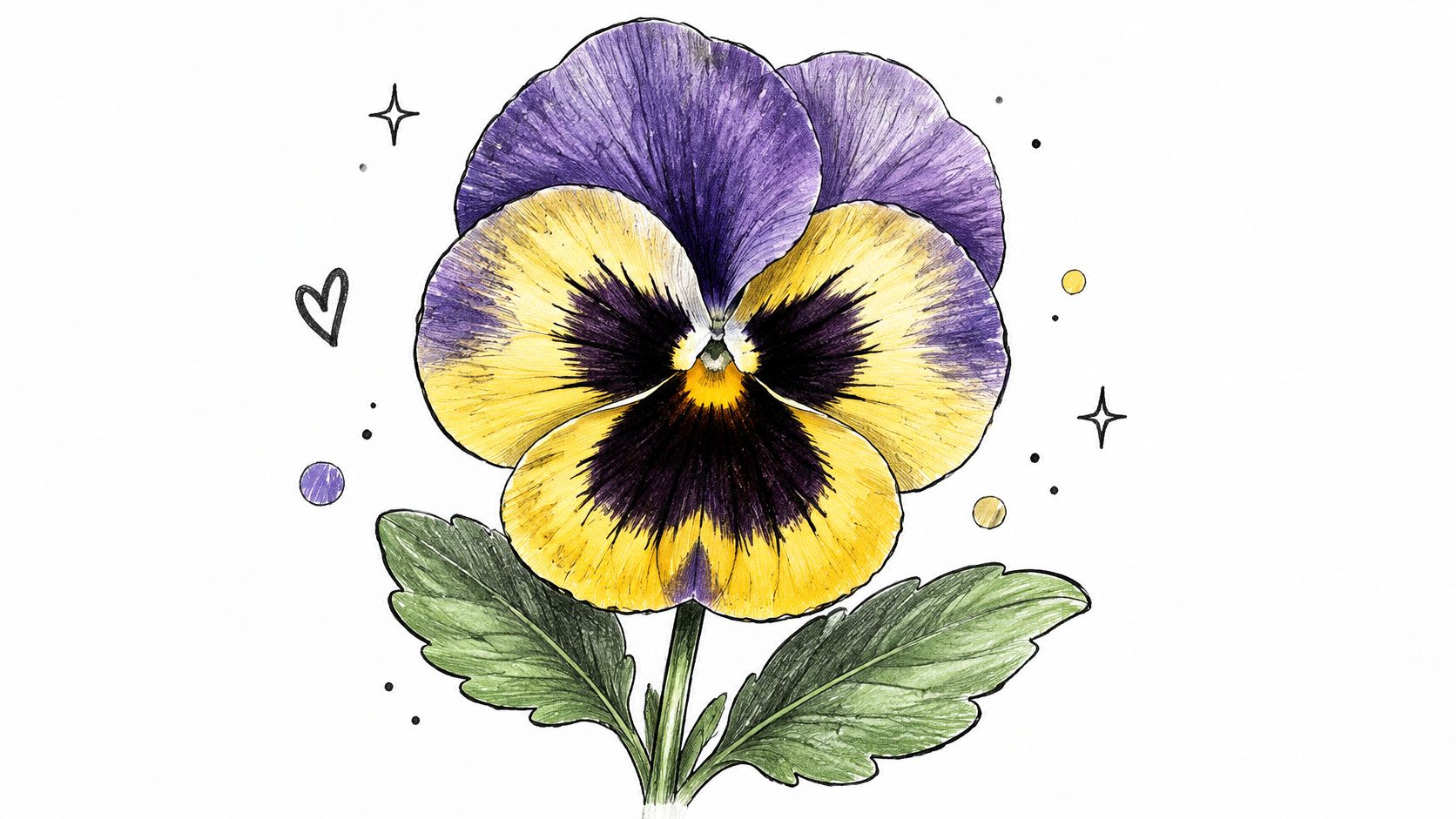
For spring stationery or cute sticker sets, let the existing markings do most of the work. A review of floral pigmentation in Annals of Botany explains the importance of floral contrast and patterning, including signals that differ between human and pollinator vision. A face-like appearance to us isn't, by itself, evidence that a flower communicates a face to an insect.
Practical rule: Ask for petal markings before asking for an expression. Otherwise, you risk getting a cartoon face pasted onto a flower.
Prompt: Pansy flower with dark violet face-like petal blotches, yellow and lavender bicolor petals, delicate dew, pastel background, spring colored-pencil illustration, natural flower structure, no mouth or separate eyeballs.
Style tags: Colored pencil, pastel botanical, cute stationery.
The softer illustration style suits greeting cards and seasonal posts. Photorealism preserves texture better, but exaggerated facial language can make the result unsettling rather than friendly.
For a coordinated Instagram carousel, keep the same violet blotches while changing the surrounding pastel background. The color palette generator guide can help you plan a consistent palette instead of introducing unrelated colors into every image.
Start with gazania when you want multiple eye-like spots arranged around a center. Dark markings near the petal bases contrast with bright orange, yellow, or pink petals, producing a graphic bull's-eye effect. Its sun-loving character and saturated colors suit summer campaigns and Mediterranean-inspired visuals.
The practical difference from Black-eyed Susan is placement. Here, the important marks belong near the bases of the petals, not inside a dark central disc. If you omit that relationship, the image can lose the feature that makes gazania useful.
Prompt: Fully open Gazania rigens flower, vivid orange petals with distinct dark eye-like spots near each petal base, golden central disc, sunlit garden, crisp botanical detail, overhead composition, natural petal arrangement.
Style tags: High-detail botanical, saturated summer color, graphic macro.
Floral patterns can help insects orient at close range, while larger flower displays matter farther away, according to a review of floral visual signals. For your artwork, that suggests a useful visual hierarchy: establish the flower silhouette first, then make the inner markings readable in a close crop.
If you photograph your own reference, choose a fully open bloom in sunlight. Check that highlights haven't washed out the dark petal-base details before using it to guide an image variation.
Pale petals around a deep purple-black eye create drama without a bright palette. Flower of an hour pairs cream or pale yellow petals with a concentrated dark center. Its short-lived blooms also offer a fitting visual metaphor for fleeting summer moments or limited seasonal collections.
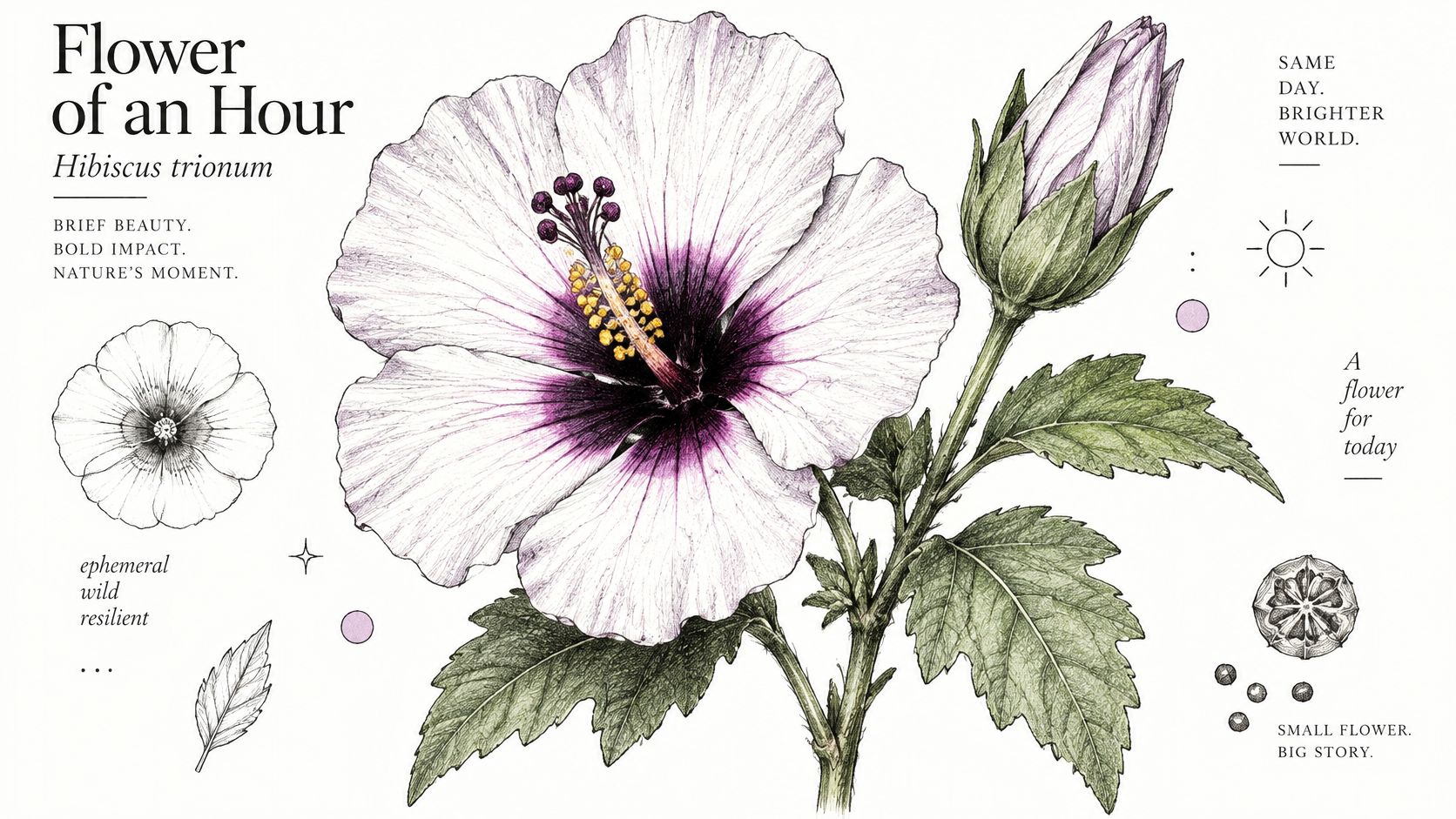
Don't confuse this human-visible dark center with an ultraviolet photograph. A study of Australian floral bull's-eye patterns describes UV-absorbing centers surrounded by UV-reflecting petals, including patterns that look different through bee-vision imaging. That distinction matters if you're making educational content: a violet artistic glow isn't a literal depiction of ultraviolet vision.
Prompt: Hibiscus trionum flower with pale cream-yellow petals and a deep purple-black central eye, visible staminal column, delicate morning dew, fine botanical watercolor, softly lit paper background, anatomically grounded flower.
Style tags: Botanical watercolor, delicate naturalism, muted cream and plum.
Keep the reproductive structures visible. A dark center with no floral detail can read as a hole rather than part of a living bloom.
Use this prompt for a quiet seasonal Instagram post, an indie poetry cover concept, or a limited-edition print mockup. A warm paper background supports the delicate petals; a black background creates more drama but can swallow the central eye.
For a useful variation, change only the medium from watercolor to fine ink and wash. Keep the flower's structure and palette stable so you can judge the effect of the style rather than an entirely different composition.
The mirror orchid offers something more unusual than a circular center: an iridescent blue patch on a dark, velvety lip. This Mediterranean orchid mimics a female wasp and attracts male wasps through sexual deception. Its eye-like appearance is a human interpretation of a more specialized pollination relationship.
That makes it an excellent reference for fantasy plant creatures, but a poor candidate for a generic daisy prompt. The distinctive feature belongs on the orchid's lip, not in the middle of a ring of interchangeable petals.
Prompt: Ophrys speculum mirror orchid, intricate orchid anatomy, dark velvety lip with an iridescent blue mirror-like patch and fine textured border, botanical fantasy illustration, subdued Mediterranean scrub background, no human eye.
Style tags: Dark botanical fantasy, iridescent detail, natural-history illustration.
This combination suits an RPG plant-creature concept or a moody book-cover study. Keep the first version close to the botanical reference, then introduce fantasy features through surrounding foliage or lighting rather than immediately replacing the blue patch with an eyeball.
Keep the caption precise about the mechanism. A review of floral signals and pollinator discrimination explains that experience and overlapping signals can affect how pollinators distinguish rewarding flowers from deceptive mimics. Don't reduce that complexity to a claim that the orchid's blue patch works like a bee's nectar guide.
Not every flower eye needs a dark pupil. Morning glory reverses the contrast, placing a pale, star-like throat inside a purple trumpet-shaped bloom. That bright center gives you a softer, luminous focal point for summer graphics and dreamy botanical artwork.
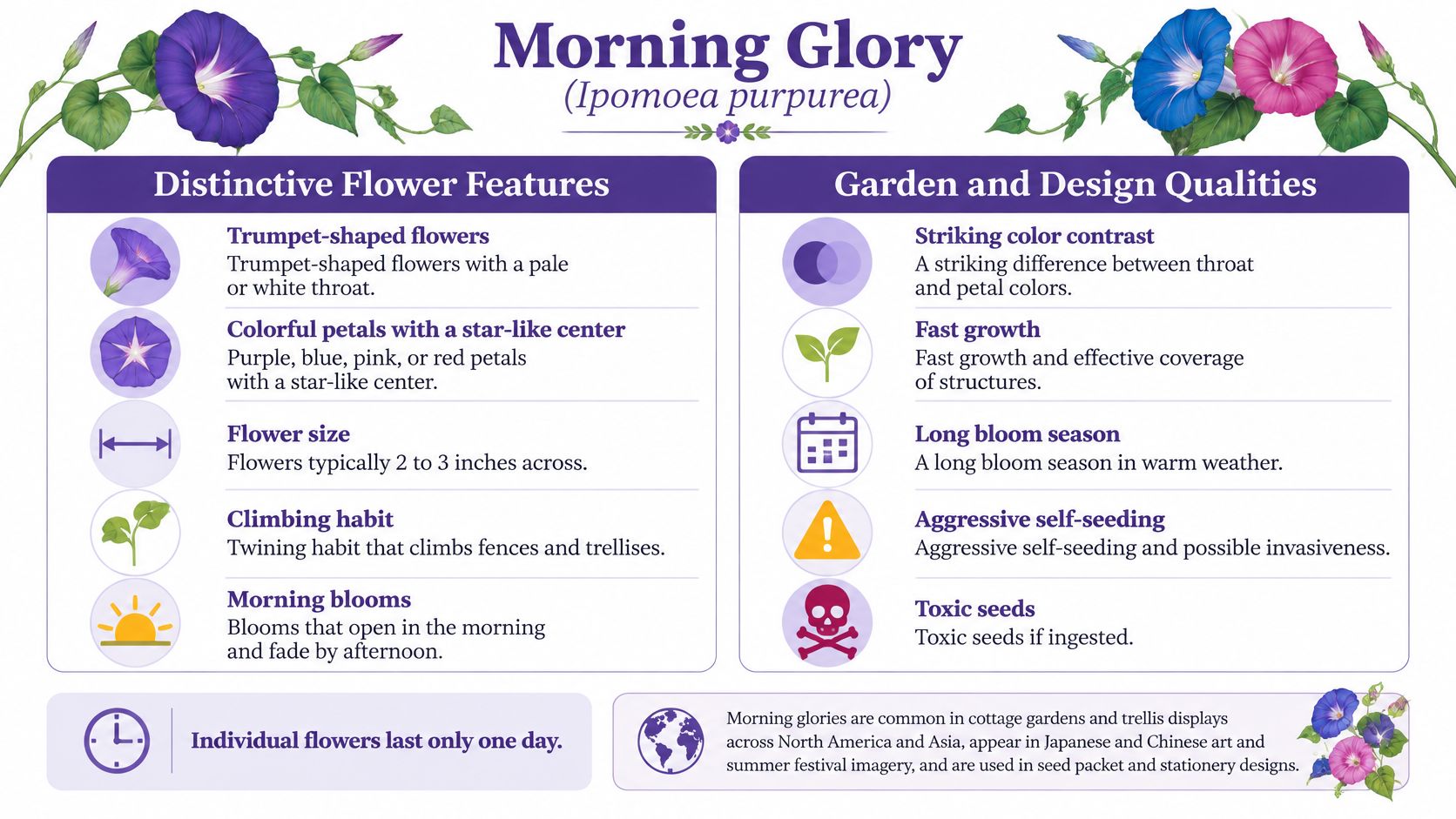
The climbing vine also adds compositional options. You can curve a stem around a title, frame a portrait concept with leaves, or isolate a bloom for stationery. Keep a trellis subtle if you include one, since hard background lines can compete with the soft flower.
Prompt: Morning glory vine with purple trumpet-shaped flowers and pale white star-like throats, delicate dew, soft morning light, translucent watercolor washes, gently curling stems, uncluttered background, no eyeballs.
Style tags: Watercolor botanical, dreamy summer, translucent petals.
The common failure is excessive glow. A luminous white center can become a light source that obliterates the trumpet's depth, so ask for visible throat shading if the flower starts looking flat.
For a seasonal TikTok background, place the main bloom away from interface elements and reserve quieter space for text. For stickers, simplify the vine and request a clean silhouette; the AI clipart guide is a relevant starting point for planning that treatment.
A study of Neotropical floral ultraviolet patterns connects bull's-eye patterns with pollination systems. It doesn't establish that every pale flower throat has an identical function, so describe this design as a human-visible star-like eye rather than a proven pollination mechanism.
A Sweet William flower head gives you a cluster of small eye-like centers rather than a single stare. Many varieties have contrasting rings around individual blooms, creating a layered pattern across the cluster. That repetition is the main creative advantage for cottage-garden graphics, wrapping paper, and textile concepts.
Start with a close crop if the rings matter. A distant bouquet may preserve the overall red, pink, and white palette while losing the detail that makes the flower distinctive.
Prompt: Sweet William flower cluster with distinct red eye-ring patterns around the centers of small pink and white blooms, finely fringed petal edges, soft pastel background, vintage garden illustration, clearly separated individual flowers.
Style tags: Vintage botanical, cottagecore, soft gouache.
The phrase clearly separated individual flowers matters. Without it, a dense cluster can become a single ruffled mass, especially when you combine painterly texture with a shallow-focus effect.
Design distinction: A ring is a pattern, not automatically an eyeball. Preserve the ring before adding any surreal interpretation.
For an Etsy wrapping-paper mockup, use isolated clusters with space between them rather than a tightly packed floral wall. For a social carousel, alternate a full flower head with a close detail of an individual ring.
Pesquisa FAPESP's account of floral nectar guides describes experiments in which spots and rings helped bumblebees find rewarding model flowers more efficiently. That supports the broader biological importance of patterned contrast, but it isn't evidence that every Sweet William ring has the same measured effect.
Keep your caption grounded in what viewers can see: contrasting rings, clustered blooms, and a vintage garden palette.
| Item | Eye Feature | Main Color | Best Social Use |
|---|---|---|---|
| Black-eyed Susan (Rudbeckia hirta) | Bold dark central disc | Yellow with dark brown to black center | Botanical art and print design |
| Pansy (Viola x wittrockiana) | Dark face-like central blotch | Purple, yellow, white, or bicolor | Seasonal imagery and cute stickers |
| Gazania (Gazania rigens) | Dark eye spots near petal bases | Orange, yellow, pink, or bicolor | Fabric and wallpaper patterns |
| Flower of an Hour (Hibiscus trionum) | Purple-black central eye | Pale yellow or cream with a dark center | Seasonal or limited-edition merchandise |
| Mirror Orchid (Ophrys speculum) | Iridescent blue patch on a dark lip | Dark velvet with an iridescent blue patch | Fantasy art and character concepts |
| Morning Glory (Ipomoea purpurea) | Pale throat forms a star-like center | Purple, blue, pink, or red with a pale center | Seasonal social media graphics |
| Sweet William (Dianthus barbatus) | Contrasting rings or eye zones | Red, pink, white, or bicolor | Textile and wallpaper patterns |
Choose the bloom by the kind of attention you want to create. Black-eyed Susan gives you a bold central disc, pansy suggests a friendly face, and gazania supplies repeated petal-base markings. Flower of an hour and mirror orchid suit darker concepts, while morning glory and Sweet William work well for softer seasonal designs.
Keep the botanical feature fixed while changing the treatment. Start with a clear description of the flower, its eye-like marking, and the composition. Then test a small group of compatible style tags rather than mixing macro photography, watercolor, glossy animation, and engraving in the same prompt.
Crop tightly for a TikTok vertical composition, but leave room for captions and interface elements. Compare a bold-contrast treatment with a soft-pastel version using the same basic framing. Don't assume that a dramatic image will hold attention longer; use your own post results to decide which direction deserves another variation.
Check details before publishing. Look for merged petals, displaced centers, invented facial features, and unreadable rings. If you're preparing a product listing, inspect the artwork at its intended print size rather than judging it only as a large preview.
A convincing flower with eyes doesn't need to look human. Often, the stronger choice is a recognizable bloom whose real markings become expressive through careful framing, contrast, and light.
starryai offers text-to-image generation and creative editing tools for turning botanical descriptions into visual concepts. Visit starryai, try the prompt for your chosen bloom, and refine its eye-like pattern into a social post, sticker concept, or botanical fantasy illustration.


