


Written by Mo Kahn on
July 23, 2026


You're staring at a blank prompt again, trying to make a character feel fresh. You type in a few details, hit generate, and the result looks polished but oddly familiar, like a thousand other faces you've already seen. That's usually the moment creators realize the issue isn't just the model, it's the prompt, the references, and the assumptions hiding inside both.
Diverse representation gives you a better way to create. It helps you move past default visuals and into images that feel lived-in, specific, and more believable. In AI art, that matters because the strongest images don't just look different, they suggest a world with real people in it.
The easiest way to think about diverse representation is this. It's not a decoration you add at the end, and it's not a quota you check off. It's the practice of showing people from different backgrounds and lived experiences in a way that feels accurate, fair, and human.
A common mistake is to treat it like a palette swap. A prompt says “fantasy warrior,” and the model gives you the same body type, the same face shape, the same age, the same visual default. A more thoughtful prompt asks for a person whose identity and appearance shape the image, such as age, disability, clothing, expression, hairstyle, and social context.
The definition matters because media representation is broader than appearance alone. A core, globally used definition describes it as the accurate and fair portrayal of people from different backgrounds and lived experiences, including race, ethnicity, gender, sexual orientation, disability, religion, age, and socioeconomic status, and UNESCO frames media diversity as the degree to which media reflects the variety of cultural, social, and political perspectives in the populations it serves. That gives creators a practical standard, not just a moral slogan, as defined in this media diversity overview.
In AI art, representation becomes a design choice. You decide whether your image will feel generic or grounded. That means thinking about who is present, who is missing, and whether the person in the image reads as a full character or a visual placeholder.
Practical rule: If the prompt could describe almost anyone, it'll probably generate someone forgettable.
This is why inclusive prompting often creates stronger art. Specificity gives the model more to work with, and audiences can feel the difference. A character with visible age, textured hair, distinctive clothing, and a clear setting tends to read as a person, not a stock pose.

Authentic representation does more than signal good intentions. It opens up better storytelling choices, and those choices are often what make an image memorable. When you stop relying on the same visual defaults, you start finding combinations of features, emotions, clothing, and settings that feel more original.
A character who looks and feels specific carries more narrative weight. A reader or viewer can infer history, role, and mood faster when the portrait includes real details instead of vague stereotypes. That's one reason inclusive visuals tend to feel richer, even when they're simple compositions.
The bigger point is that representation is tied to creative control. The 2025 UCLA Hollywood Diversity Report found that in 2024, BIPOC talent exceeded proportionate representation in streaming film leads, while BIPOC talent remained underrepresented behind the camera as directors at 41% and writers at 30%. The creative lesson is clear, visibility on screen doesn't automatically translate into authorship. For AI art creators, that's a reminder to think beyond surface diversity and consider who gets to shape the image itself.
Mainstream visual culture still leaves gaps, and that creates room for independent creators to do more interesting work. If your output keeps repeating the same face, same body, same age, and same aesthetic, your portfolio blends into the noise. If your images reflect a wider range of identities with care, they feel more contemporary and more believable.
Diverse representation also helps you avoid stale clichés. A fantasy queen doesn't need to look like every other fantasy queen. A sci-fi engineer doesn't need to be coded the same way every time. A street portrait can feel more truthful when it shows age, texture, style, and personality instead of chasing a narrow ideal.
Creative advantage: Specificity isn't a constraint. It's often the quickest path to images that feel alive.
The result is not just ethical. It's competitive. Viewers notice when an image has thought behind it, and thoughtful images are easier to remember, share, and build into a larger body of work.
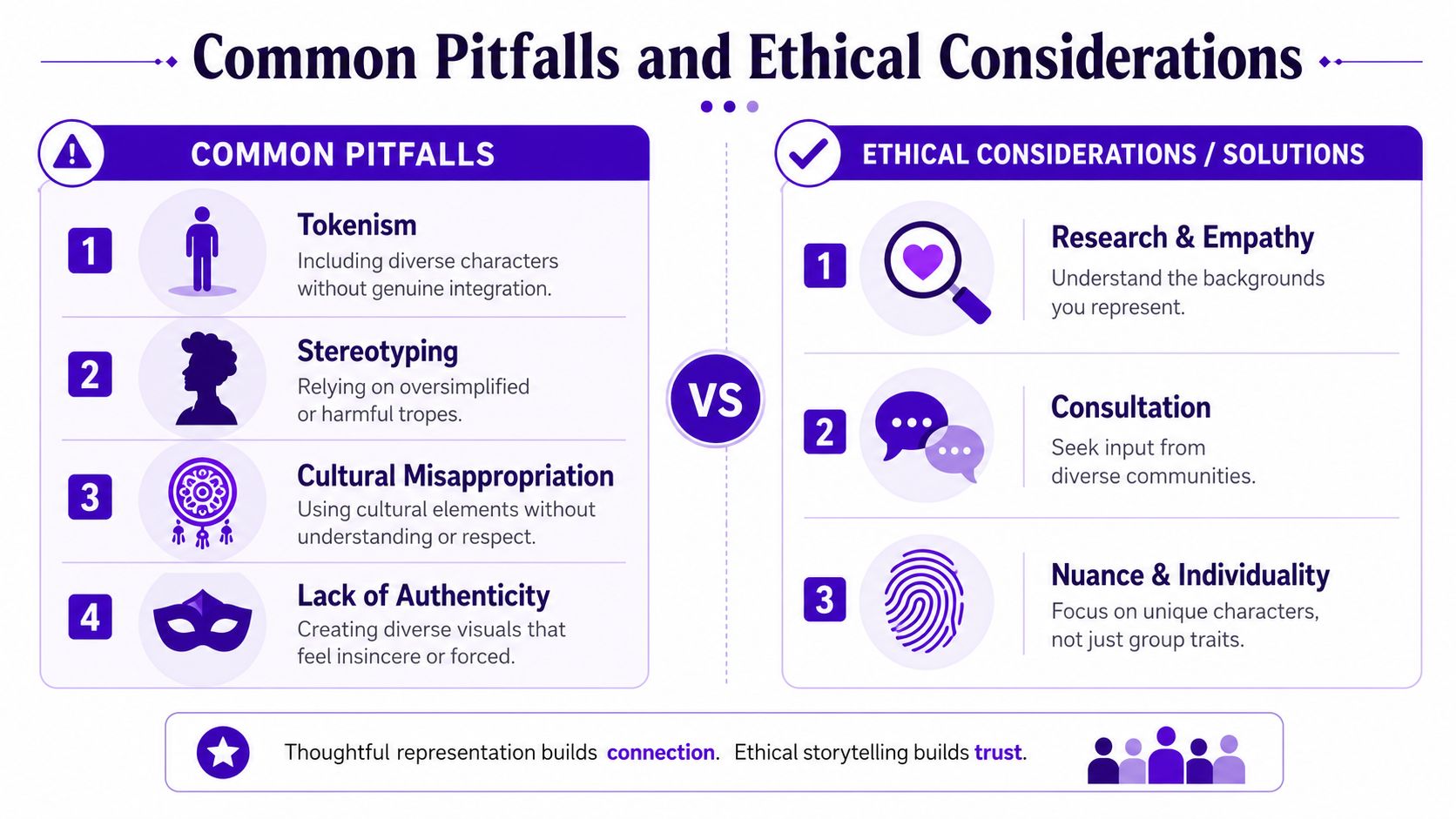
Inclusive visuals can go wrong in ways that are easy to miss at first glance. The most common problems are tokenism, stereotyping, cultural misappropriation, and flat authenticity. None of them usually happen because a creator meant harm, but intention doesn't cancel impact.
AI models are trained on existing data, so they can repeat the blind spots and imbalances already present in that data. A meta-analysis of 190 accessibility datasets found significant gaps in gender and race and ethnicity representation, showing that AI performance can be biased when training data isn't balanced across intersecting identities like disability, age, gender, and race, as detailed in this accessibility dataset analysis. That matters for artists because the model may reach for familiar patterns unless you guide it away from them.
Tokenism is the easiest trap to spot. It happens when a prompt adds diversity as an accessory, not as part of the character. Stereotyping is worse because it turns identity into a shortcut. Cultural misappropriation happens when a visual borrows symbols without understanding their context or meaning.
The fix starts with research and empathy. If you want the image to feel respectful, you need to understand what details belong together and what details don't. That doesn't mean becoming an expert on every culture before you create, it means slowing down enough to avoid lazy shorthand.
A useful reminder comes from starryai's content policy, which sits alongside the broader principle that creators should avoid flattening people into stock identities. The strongest prompt choices usually come from asking what makes the character specific, not just what group label they belong to.

The best inclusive prompts usually start with a subject, then layer in details that change how the subject reads on screen. If you're only typing “an old woman,” the model has too much freedom to default to generic features. If you describe age, heritage, expression, hair texture, clothing, and setting, you're giving the system a clearer visual brief.
In health research, experts argue that simple demographic labels like race or age are only proxies for deeper drivers of outcomes, and that point translates well to art. For authentic representation, creators should focus on capturing context and lived experience, not just checking a demographic box, as discussed in this research summary. In practice, that means asking what the character does, where they are, how they carry themselves, and what details tell that story.
A useful prompt formula looks like this:
subject + identity details + expression + setting + style + camera or composition notes
That structure keeps you from overloading the prompt with random adjectives. It also makes each layer do a different job. The subject tells the model who the image is about, the identity details shape the person, and the setting anchors the scene.
Try to describe identity with precision, not cliché. Instead of “an old woman,” use a phrase like “a Ghanaian woman in her 70s with laugh lines and silver coily hair.” Instead of “a disabled man,” focus on how he appears in the scene, the assistive device, his posture, his clothes, and the environment around him. Those details help the image feel considered rather than generalized.
Prompting rule: The more visible the lived context, the less the image depends on stereotype.
If you want a practical reference for structure, this starryai prompt guide can help you think about how to organize details without making the prompt messy. Use it as a drafting aid, then return to the core question, does the prompt show a real person or just a category?
Here are a few modifier ideas that often improve inclusivity:
The goal isn't to stack labels. It's to write a prompt that feels like a character brief, not a demographic report.
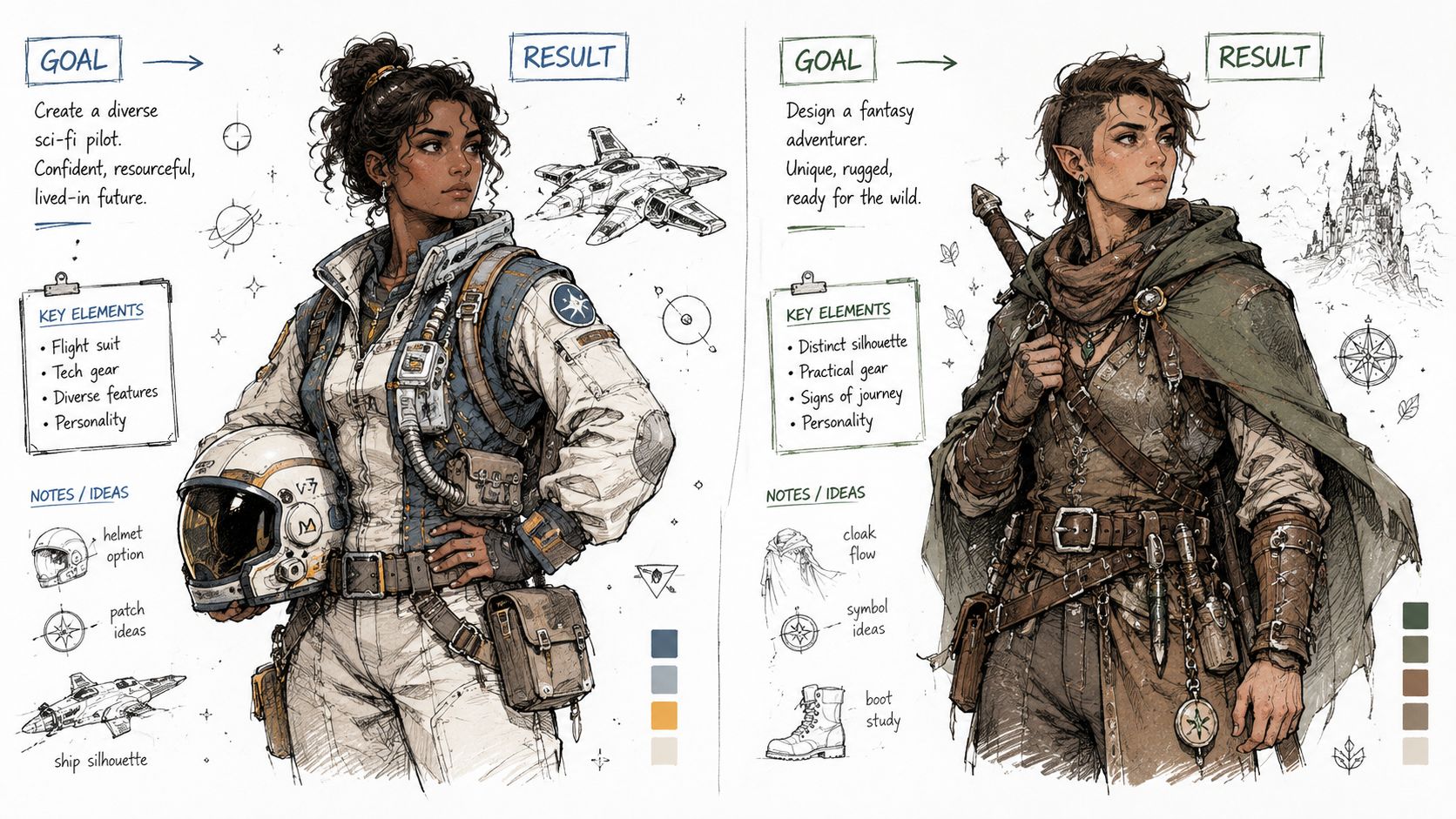
A good way to test your instincts is to compare a default prompt with a more deliberate one. The difference is usually obvious in the final image, because the revised version gives the model a clearer human center.
A generic prompt might read, “sci-fi pilot portrait, futuristic suit, dramatic lighting.” That often produces a polished but forgettable character, the kind of face you've seen in dozens of concept images. There's style, but not much identity.
A stronger version could be, “Black nonbinary pilot, short natural hair, worn flight jacket with mission patches, calm expression, cockpit reflections, cinematic side lighting.” That prompt doesn't just diversify the image, it changes the mood. The character feels like someone with a job, a history, and a presence in the world.
A default prompt like, “female fantasy adventurer with sword, heroic pose” tends to generate a familiar template. The result can look competent and bland at the same time. Nothing in it tells you who this person is beyond the role.
A more inclusive prompt might say, “South Asian woman in her 40s, muscular build, weathered cloak, ornate but practical boots, scar across one eyebrow, standing in a mountain pass at dawn.” Now the image has age, texture, and physicality. It also feels more grounded because the details support the character instead of decorating her.
For a more everyday image, try this contrast. “professional woman, office background” is broad enough to be almost meaningless. It can produce a stereotype of success rather than a real professional.
A better version is, “Latina project manager in her 30s, braided hair, relaxed blazer, confident posture, bright coworking space, natural expression.” The portrait becomes more vivid because the prompt narrows the scene and humanizes the subject at the same time.
The pattern across all three examples is simple. When you describe people with care, you get more interesting art. When you rely on defaults, you get more repetition.
Diverse representation isn't a box to tick once and forget. It's a habit, a lens, and a creative discipline. The strongest images usually come from prompts that treat people as individuals first, not as placeholders for identity labels.
That shift changes your work in three ways. It makes your art more original, because you stop leaning on the same visual defaults. It makes your process more ethical, because you're paying attention to how people are shown. And it gives you more control, because specific prompts create more specific results.
You don't need to get everything perfect on the first try. You do need to keep noticing when an image feels generic, when a prompt relies on shorthand, and when a character needs more context to feel real. That awareness is what turns inclusive creation into a skill instead of a slogan.
Keep testing new prompts, refining your references, and building images that reflect more of the world people live in. If you want to turn those ideas into fast visual experiments, start creating with starryai.


.svg)