

Written by Mo Kahn on
August 30, 2026


The phrase “deer head explodes” sounds like a single shock image, but it describes several different visual ideas, from crystalline fragmentation to a collar battery exploding near a deer without major injury to the animal. A 2025 podcast summary distinguishes that device incident from the sensational wording, while a November 2024 dash-cam clip showed a deer hit by a semi with its antlers flying off, according to the supplied background references. The subject works because you can control the material, emotional tone, lighting, motion, palette, composition, and intended platform instead of relying on one generic blast effect.
That makes starryai useful for text-led visual testing. You can keep the deer head and camera angle consistent, then change one creative control at a time across seven concepts: crystals, cosmic particles, digital glitches, watercolor, bioluminescent cracks, organic dispersion, and mirror distortion. Each prompt below focuses on visual identity, practical prompt levers, audience fit, trade-offs, safety framing, and a format suited to social posts, covers, games, or merchandise. If your concept leans toward hunting remembrance rather than surreal destruction, compare it with this memorial deer hunting sticker.
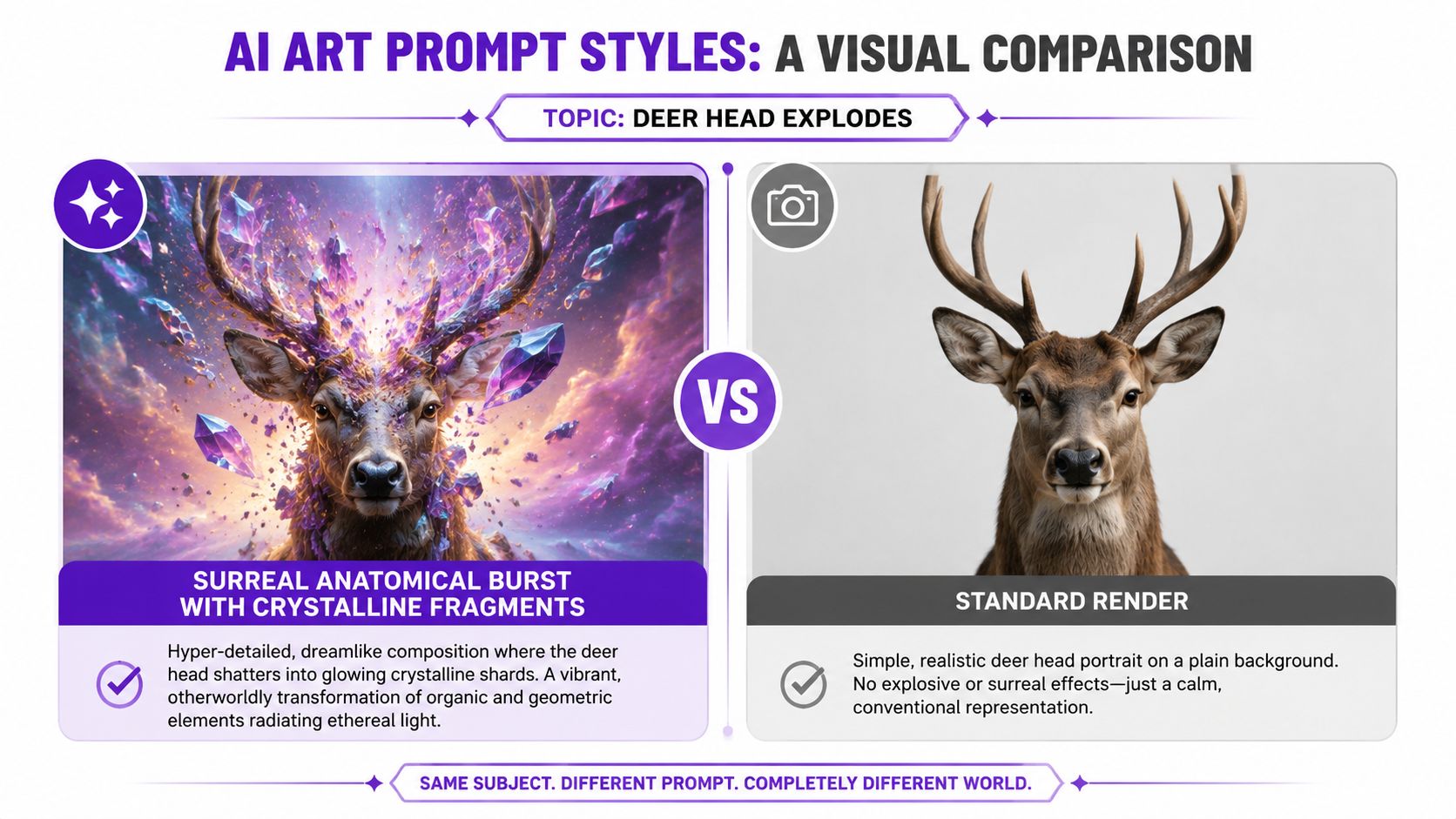
A crystalline burst gives the deer head explodes concept a clean visual grammar. The anatomy stays recognizable while the transformation replaces a literal violent impact with faceted shards, radiating light, and geometric separation. That balance matters for book covers and album art, where the viewer needs to identify the subject quickly but still discover detail on a closer look.
Start with a prompt such as: hyper-realistic whitetail deer head, antlers intact, exploding into glowing crystalline fragments, cool blues and purples, ethereal and haunting mood, dark forest background, dramatic rim light, centered composition, sharp anatomical detail, digital art. Replace the palette with warm golds and crimsons when you want heat, danger, or a more theatrical fantasy tone. “Oil painting” softens the geometry, while “hyperrealistic” and “digital art” keep the result crisp.
The visual trade-off is straightforward. More fragmentation creates energy, but it can erase the face and antler silhouette. Run multiple generations, then choose the version where the eye, muzzle, and antler structure remain legible. The same prompt logic works well for creature concept art, particularly when a tabletop RPG character needs a memorable transformation rather than a realistic wildlife portrait.
Practical rule: Keep the background quiet when the shards carry the story. A busy forest can compete with the transformation.
For TikTok, use a stable portrait crop for the initial deer image, then reveal the crystalline version as a before-and-after transition. For merchandise, test the design at small size. Thin shards and subtle facial details may disappear on a sticker or shirt, while a stronger silhouette will reproduce more reliably.
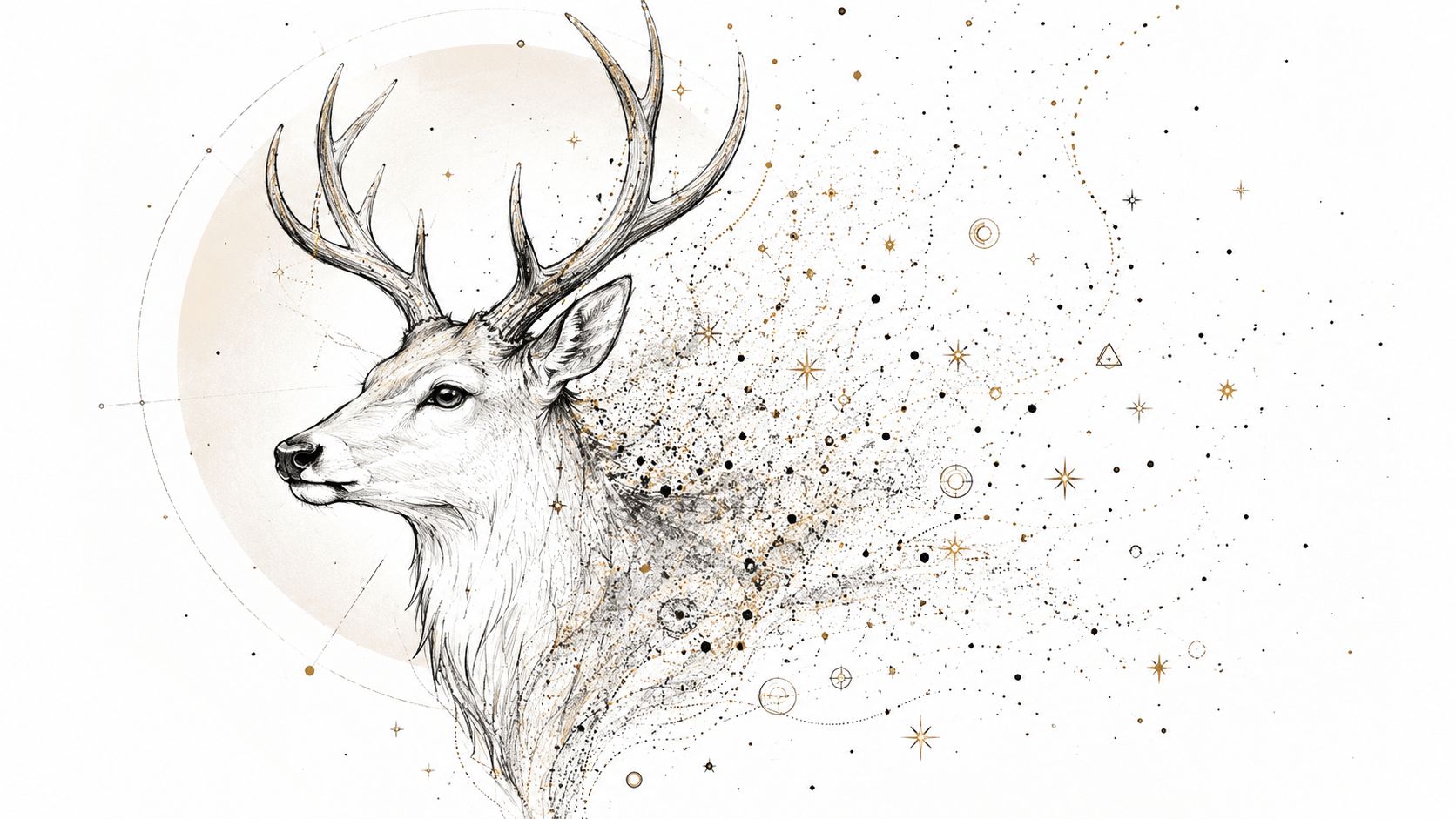
A dissolving deer head feels less destructive than a shattering one. The subject gradually becomes stardust, luminous particles, or cosmic debris, which gives the image a meditative and transcendent mood. That makes it a better fit for wellness graphics, spiritual content, peaceful game environments, and reflective social posts than for aggressive gaming artwork.
Use a prompt like: deer head slowly dissolving into golden dust and crystalline particles, soft circle behind the subject, deep blue and violet gradient, gentle light from the upper left, contemplative atmosphere, floating particles, clean negative space, mystical digital illustration. Lighting direction helps create movement. A light source from the left can pull particles across the frame, while a centered glow produces a calmer icon-like result.
Color carries much of the emotional meaning. Blues and purples suggest calm and distance, while gold adds warmth and a sense of illumination. The main risk is visual flatness. If every particle has the same size and brightness, the image can look like a decorative filter rather than a transformation. Ask for varied particle scale, a denser core near the antlers, and a lighter scatter toward the edges.
For a mindfulness app graphic, leave open space beside the head for interface copy. For an ASMR-style transition, generate matching frames with the deer increasingly dissolved, then edit them into a gradual sequence. Layering separate generations can add depth, but inconsistent anatomy between frames may make the motion feel abrupt. Select outputs with similar head placement before combining them.
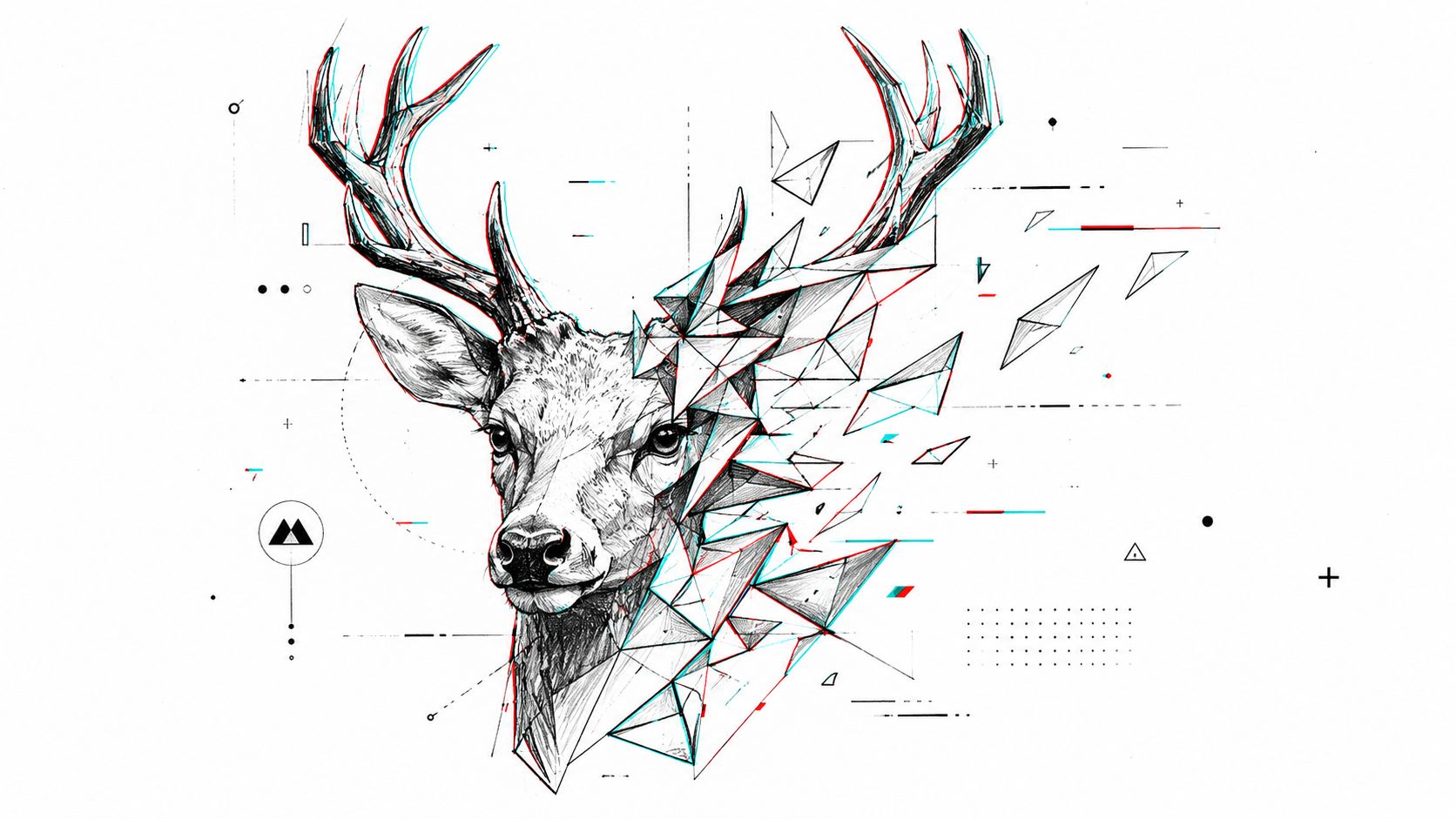
Digital glitch turns the deer into a collision between wildlife photography and cyberpunk design. Instead of organic debris, the head breaks into polygons, scanline errors, RGB separation, and sharp digital interruptions. This visual identity suits esports graphics, gaming overlays, streamer art, and technology-focused campaigns.
A useful prompt is: front-facing deer head fragmenting into hexagonal and triangular shards, subtle digital glitch, RGB color separation, neon cyan and magenta, black background, sharp polygonal breaks, cyberpunk interface texture, high contrast, centered logo-friendly composition. Start with “subtle glitch” if the antlers need to remain readable. Change it to “heavy digital distortion” only after you've found a strong base composition.
You can use the abstract AI generator as a reference point for developing the fragmented visual language, then refine the deer-specific prompt with a fixed palette and camera position. Specify hexagons, triangles, or shattered glass rather than asking for “cool shapes.” Concrete geometry gives the model a clearer direction.
The trade-off is readability versus disruption. A streamer may want intense distortion for a transition card, but a team emblem needs a stable outline that survives compression and small display sizes. Generate variants at subtle, medium, and heavy glitch intensity, then assign each to a different use rather than forcing one file to do everything.
For social adaptation, crop the antlers so they touch the top edge of a vertical frame, keeping the face near the center safe area. For an esports banner, reserve one side for the team name. Avoid placing essential RGB offsets behind typography, since color separation can make both the deer and the text appear blurry.
Watercolor changes the emotional temperature completely. The deer head doesn't appear to detonate; it loosens into pigment, flowing washes, and ink blooms. That handmade quality works for literary fiction, poetry, fantasy novels, Etsy prints, and Bookstagram content where softness can communicate more than spectacle.
Try: deer head dissolving into indigo and burnt sienna watercolor washes, expressive ink bleed, watercolor study on textured cotton paper, visible brush edges, organic flowing shapes, restrained antler detail, quiet dark forest background, gallery-style composition. Naming the paper texture helps avoid a sterile digital finish. “Cold-press paper,” “rough paper grain,” and “ink wash technique” each push the surface in a different direction.
The AI watercolor generator can support this direction, but the prompt still needs a clear hierarchy. Specify whether the deer remains detailed while the edges dissolve, or whether the entire form becomes abstract. If both the anatomy and the background receive heavy washes, the subject may lose its focal point.
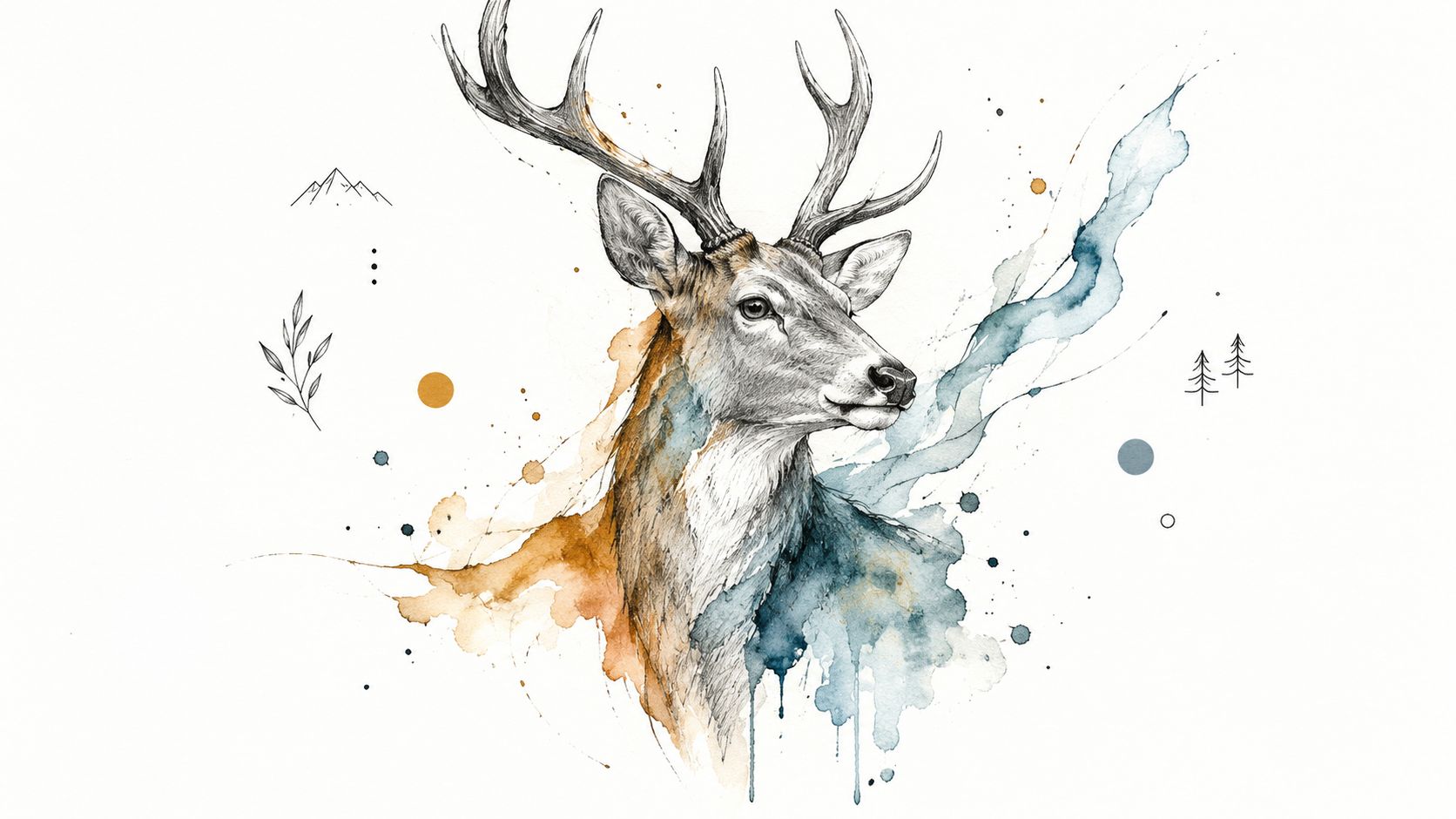
“A handmade look needs controlled imperfection, not random softness.”
For a book series, lock the paper tone and primary ink color before generating separate covers. Use indigo for a cool, introspective identity, sepia for historical or rustic fiction, and burnt sienna for warmth. You can layer generations in editing, but check that the washes share a similar direction. Conflicting flow patterns make the cover look assembled rather than painted.
A print-on-demand design also needs breathing room. Leave unpainted paper around the antlers and avoid relying on very pale washes for the main subject. The stronger version often has one dark anchor, such as the eye socket or antler base, surrounded by lighter bleeding color.
Bioluminescent cracks create a science-fiction fantasy hybrid. The deer head appears to split from within, with neon energy glowing through the fractures while the dark background increases contrast. This concept performs best as a high-impact visual for gaming, tabletop RPGs, sci-fi fiction, and short-form video transitions.
Build the prompt around light behavior: deer head shattering with glowing bioluminescent cracks, cyberpunk purple and cyan underglow, dark atmospheric background, high contrast, luminescent fragments, neon-lit antlers, dramatic backlight, centered fantasy character art. The words “glowing,” “luminescent,” and “neon-lit” reinforce emission, while “dark atmospheric background” protects the glow from flattening.
The palette should have a dominant and supporting color. Cyan with purple creates a technological mood, while mystical green with violet feels more arcane. Asking for every neon color at once often produces muddy highlights. Generate separate color variations for overlays, character cards, and merchandise rather than trying to serve every audience with one palette.
A real-world use case is a tabletop campaign reveal. The first frame can show a normal deer emblem, followed by the cracked version when a supernatural forest faction enters the story. Keep the antler tips inside the crop if the artwork will become a vertical thumbnail. They're useful recognition points, but clipping them can make the image read as an anonymous horned creature.
For merchandise, inspect the design against dark and light garment colors. Neon effects that look strong on black may disappear on pale fabric, while a dark outline around the head can preserve separation. For animated content, use the brightest version only at the reveal moment. Constant maximum glow reduces the sense of change.
This concept depends on contradiction. The head breaks apart, but the materials are soft fur, feathers, natural fibers, and drifting organic fragments rather than glass or circuitry. The result can feel tragic, beautiful, or poignant, depending on the lighting and direction of motion.
Use a prompt such as: deer head exploding upward into soft fur, feathers, and natural fibers, tragic and beautiful mood, golden hour light, dramatic shadows, detailed wildlife anatomy, particles dispersing to the right, cinematic environmental art, restrained background. Directional language matters here. “Upward” creates lift and release, while “to the right” leaves usable negative space on the opposite side for title text or a character caption.
The key trade-off is naturalism versus visual clarity. Too much fur can make the image look like a cloud, while too little loses the material contrast that defines the idea. Keep the head and antlers solid near the center, then let the fibers become looser toward the edges. “Detailed texture” helps the viewer understand what is moving, but “restrained background” prevents the forest from competing with it.
An indie game trailer might use the image as key art for a character death scene, while a wildlife-themed fine art print might remove the most violent cues and emphasize wind, feathers, and golden light. Those are different audiences, so the prompt should reflect the intended emotional reading instead of treating destruction as automatically dramatic.
Generate multiple viewpoints if the artwork supports a film or animation pitch. A three-quarter view gives more depth, while a profile makes the dispersion direction easier to read. For sensitive audiences, avoid gore descriptors and frame the effect as symbolic transformation. That choice keeps the image intense without presenting fictional violence as documentary evidence.
Mirror shatter is the most conceptual option in the set. Each fragment can reflect a different version of the deer, creating identity fragmentation, recursive mirroring, and fractured reality. The subject becomes a question about perception rather than a simple object undergoing destruction.
Try: deer head breaking like a shattered mirror, every fragment reflecting a distorted alternate deer, identity fragmentation, fractured reality, monochromatic silver and charcoal palette, infinite reflections, recursive mirroring, psychological thriller concept art, precise central composition. Use “perfect mirror reflections” for a controlled, graphic result. Choose “distorted funhouse reflections” when the image should feel unstable or psychologically uneasy.
The strongest outputs maintain a readable original head while allowing the reflections to diverge. If every shard contains a complete deer, the composition may become crowded. Ask for larger primary fragments, fewer reflections, and a clear focal eye. A limited palette also prevents the idea from turning into a general fantasy collage.
This approach fits a psychological thriller cover, a philosophy book, or a reality-bending tabletop RPG campaign. For a mental-health editorial illustration, take care with the framing. “Fractured identity” can support a thoughtful metaphor, but sensational language or graphic presentation may undermine the subject's seriousness.
A square post benefits from a centered radial composition, with the largest mirror pieces near the face. A vertical cover can place the head in the upper half and allow reflections to descend into the title area. Before publishing, check whether any reflected details resemble real people, logos, or photographic evidence. The image is a constructed visual metaphor, and its presentation should make that clear.
| Style | Implementation Complexity 🔄 | Resource / Efficiency ⚡ | Expected Outcome ⭐ / Impact 📊 | Ideal Use Cases 💡 | Key Advantages ⭐ |
|---|---|---|---|---|---|
| Surreal Anatomical Burst with Crystalline Fragments | High 🔄, intricate anatomy + fragmentation | Moderate–High ⚡, multiple generations, high-detail renders | ⭐⭐⭐⭐, gallery-quality, highly shareable (📊 high engagement) | Book covers, album art, premium merch | Unique, eye-catching, high visual complexity |
| Particle Dispersion with Cosmic Energy | Medium 🔄, smooth transitions, particle control | Moderate ⚡, gradient/particle tuning | ⭐⭐⭐, calming, trendy, meditative (📊 good for wellness audiences) | Meditation apps, wellness branding, spiritual content | Sophisticated, soothing, great for transitions |
| Geometric Fragmentation with Digital Glitch Effect | Medium–High 🔄, precise polygons + glitch control | Moderate ⚡, color/channel management | ⭐⭐⭐⭐, bold cyberpunk aesthetic (📊 strong viral potential in gaming) | Gaming, tech branding, esports, NFTs | Tech-forward, highly shareable, strong commercial appeal |
| Watercolor Dissolution with Ink Bleed | Medium 🔄, painterly unpredictability | Moderate ⚡, may need multiple attempts | ⭐⭐⭐, handcrafted, gallery-ready (📊 good with literary/fine-art audiences) | Book covers, fine art prints, indie publishing | Organic, elegant, authentic handmade feel |
| Bioluminescent Shattering with Neon Underglow | Medium 🔄, glow/contrast balancing | Moderate ⚡, color variants for prints/screens | ⭐⭐⭐⭐, neon-pop, very social-media friendly (📊 very high shareability) | Gaming/fantasy content, neon merch, thumbnails | High visual pop, Gen Z appeal, striking thumbnails |
| Explosion with Feather and Fur Dispersion | High 🔄, complex textures and motion | High ⚡, detailed texture work, high-res renders | ⭐⭐⭐⭐, emotionally impactful, cinematic (📊 strong narrative resonance) | Game cinematics, concept art, fine art | Deep emotional/visual storytelling, natural texture realism |
| Mirror Shatter with Reflection Distortion | Very High 🔄, multi-perspective reflections | High ⚡, precise rendering, conceptual framing | ⭐⭐⭐⭐, thought-provoking, complex (📊 niche but conversation-starting) | Conceptual art, psychological projects, fine art | Conceptual depth, multi-layered, highly unique visuals |
The most reliable workflow starts with one transformation concept, not seven unrelated prompts. Choose crystals, particles, glitch, watercolor, neon cracks, organic dispersion, or mirror fragments. Keep the deer species, head angle, antler structure, crop, and background relationship as stable as possible. Then vary only one control, such as material, palette, lighting, or motion, so you can tell which change produced the useful result.
Generate several alternatives in starryai and judge them at the size where people will see them. A detailed face may look impressive on a large screen but collapse into noise as a profile image. A cover concept needs title space and a clear focal point. A merchandise preview needs a strong silhouette, clean contrast, and enough separation for printing.
Audience fit should guide selection as much as visual polish. A cosmic dissolution may suit a meditation graphic, while a heavy glitch belongs in gaming content. Watercolor can support a literary audience, and mirror distortion can carry a psychological theme. Don't force a violent reading onto every version. The phrase deer head explodes is sensational, but the finished image can represent transformation, memory, magic, digital identity, or loss.
Safety and ethics also matter. Label AI-generated work when the context requires it, and don't present fictional destruction as real evidence. Consider audience sensitivity around graphic imagery, especially when posting near hunting, wildlife, injury, or animal-welfare discussions. If you sell a design, check the applicable commercial-use requirements for the tool, source material, fonts, and platform before listing it.
Use this short adaptation pass before publishing:
The same discipline also helps separate art from real wildlife incidents. A deer can lose antlers, suffer head trauma, or show disease-related swelling, but a viral phrase doesn't identify what happened in a particular clip. The National Park Service notes that epizootic hemorrhagic disease can cause visible cranial and facial swelling, spreads through biting midges rather than deer-to-deer contact, and can kill severely affected deer rapidly after clinical signs begin. That wildlife health guidance belongs in factual reporting, while the prompts above belong in clearly labeled creative work.
starryai gives you a text-to-image workflow for testing surreal transformations, including a deer head explodes concept, and its image-to-image approach can help guide changes from an uploaded reference. Visit starryai to create a controlled set of deer transformation variations for your next post, cover concept, game asset, or merchandise preview.


.svg)