

Written by Mo Kahn on
September 10, 2026


You're choosing between a functional RPG reference, a personality-led character profile, and a production-ready asset board. Each can show the same hero, yet only one may help your audience make the next decision, whether that means playing a campaign, writing a chapter, drawing a comic, publishing a book, or planning social content.
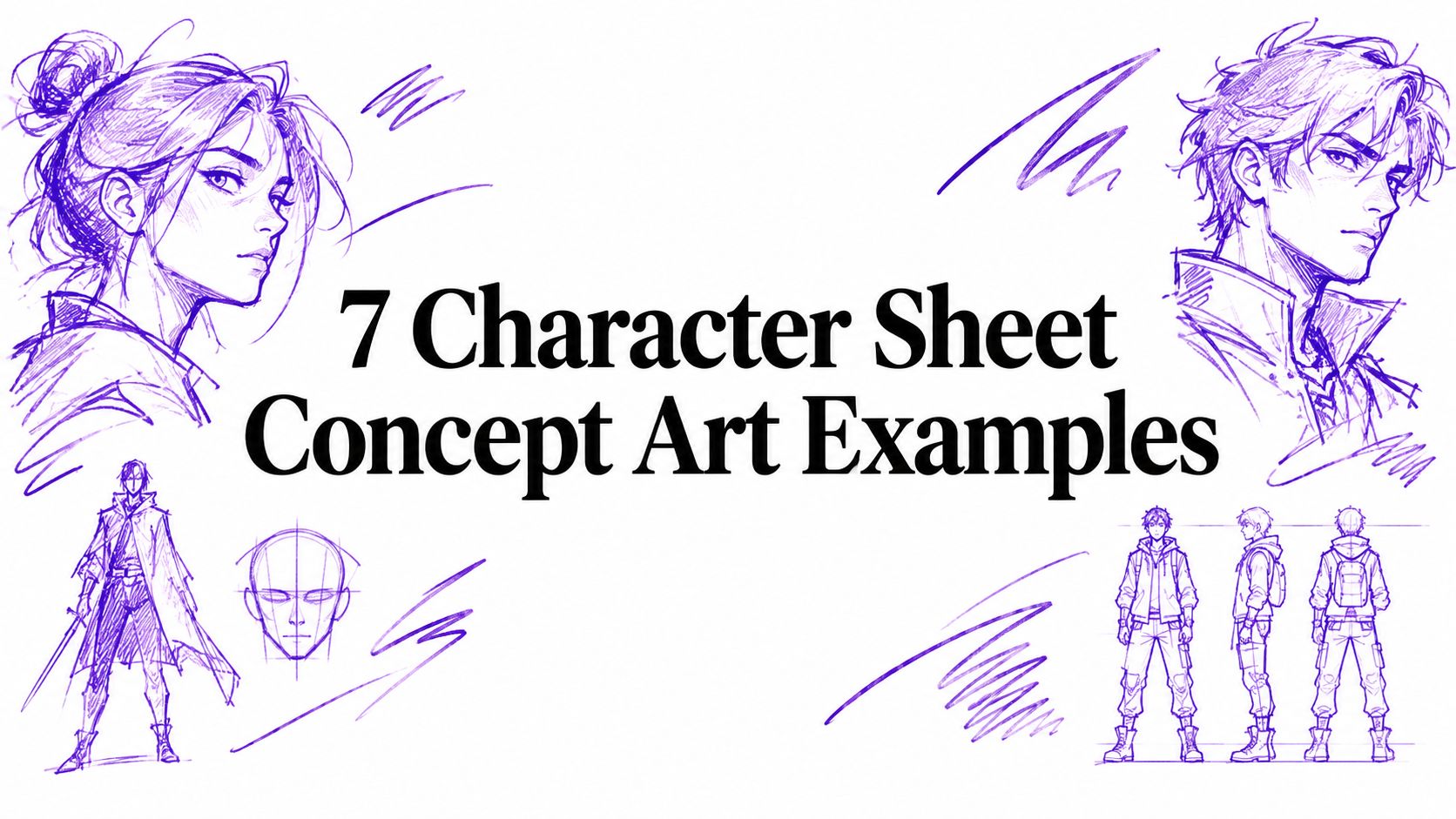
Strong character sheet concept art communicates identity quickly, then preserves enough structure for repeated use. The best sheets don't merely collect attractive illustrations. They establish a visual hierarchy, lock recognizable traits, guide future prompts, and respect the final medium. That production mindset has deep roots in animation, where model sheets became formal quality-control documents for keeping characters consistent across many artists and scenes at Disney during the 1930s and 1940s (Where Creativity Works explains the history of model sheets).
The seven formats below treat each sheet as a reusable system. You'll see how RPG layouts, anime profiles, game assets, author boards, avatars, trading cards, and portfolio pages balance visual appeal with repeatability, prompt control, and practical output. starryai can help with portraits, variations, and early concept exploration, but dense text, technical specifications, and final page composition usually belong in a separate design tool.
A fantasy RPG sheet has to work while someone's making decisions. A rugged adventurer portrait creates emotional attachment, but the player also needs readable stats, abilities, equipment, conditions, and space for notes. That makes the layout a negotiation between story identity and table utility.
Traditional examples include official Dungeons & Dragons 5e sheets, Pathfinder character templates, and custom formats built around actual play communities such as Critical Role. Their strongest shared principle is information grouping. Put combat-relevant information near the areas players consult most, while background details and visual flavor can occupy a secondary panel.

A model sheet traditionally uses multiple views, poses, and expressions to define what remains consistent. Contemporary guidance also separates concept, turnaround, construction, pose, and expression sheets, because each solves a different production problem (this character model sheet gallery outlines those functions). For an RPG version, the portrait should anchor the page, while the stats should remain editable and easy to scan.
Use starryai to explore a player portrait from a selfie and a fantasy class description, then choose the version with the clearest silhouette and strongest costume read. A useful prompt should specify the character's role, age range, body shape, signature equipment, palette, expression, and intended use as a tabletop RPG portrait. For more direction, compare that workflow with this guide to fantasy character concept art.
Keep generated art separate from the information layer. Add ability text, inventory fields, typography, and handwriting space in a layout application. Export a high-resolution version for printing on cardstock, but preserve a digital copy with open fields for annotations. The sheet succeeds when the character feels vivid without making the player hunt for the information needed during play.
An anime or manga profile often succeeds through emotional range rather than statistics. A full-body illustration establishes the silhouette, while chibi versions, expression studies, dialogue samples, and personality notes reveal how the character behaves. That combination suits manga readers, anime fans, Webtoon creators, and social audiences who understand a character through quick visual signals.
The layout can run vertically for a social post or horizontally for a reference document. Either way, give the main design the largest visual weight. Smaller expression panels should answer practical questions, such as how the character looks when embarrassed, furious, surprised, or exhausted, rather than functioning as decorative filler.
Use a restrained palette and repeat it across hair, clothing, accessories, and background accents. You can record hex codes directly on the template so a future artist or prompt can reproduce the same visual logic. The sheet should also separate fixed traits, such as eye shape or a distinctive hair clip, from flexible traits, such as seasonal clothing or exaggerated reaction poses.
starryai's text prompt feature works best here when the prompt describes both design and performance. Specify the anime-inspired rendering approach, camera distance, pose, emotion, outfit, lighting, and clean character-reference composition. Generate the core design first, then request focused variations for “happy, angry, surprised, sad” instead of asking for every possible emotion in one crowded image. The anime character template guide offers a useful starting point for organizing that process.
Practical rule: Lock the character's face, hairstyle, dominant colors, and signature accessory before expanding the expression set.
A profile can also support art for sale by style, but commercial presentation needs clarity. Don't bury the character biography beneath oversized effects or unreadable text. Let body language carry the personality, and use written notes to clarify motivations, speech habits, and contradictions that an image alone can't communicate.
A game asset sheet must survive contact with implementation. It isn't enough for the hero to look compelling in a polished illustration. The sheet should help a developer understand the sprite silhouette, animation poses, portrait crop, reference points, and intended asset constraints.
Stardew Valley sprite references, Hollow Knight documentation, and indie game development pages on itch.io show why a game-oriented sheet needs multiple visual scales. A character may require a full concept image for design approval, a small portrait for interface use, and simplified action poses for gameplay readability. These versions shouldn't drift apart.
The practical mistake is asking an image generator to produce a finished technical sheet with accurate labels, frame counts, and specifications. Generative images can establish the visual direction, but a separate design or production tool should handle exact dimensions, file formats, naming conventions, and animation documentation.
Start in starryai with a controlled base prompt for the cast. Keep the wording stable and change only the character-specific variables, such as class, colors, hairstyle, or equipment. This creates a repeatable prompt framework rather than a series of unrelated experiments. The video game character creator can support early exploration before the team converts the selected design into production assets.
For the reference image, include front, side, and action views, then mark animation reference points such as the head pivot, shoulder line, hands, hips, and feet. A 2025 game-concept-art study defines a model sheet through front, side, and back views and describes its role in helping a 3D artist represent every detail correctly (the published study is available through UPI).

The same principle applies to animation planning. Treat the generated image as a visual source, not as a technically reliable sprite sheet. Test the character at the smallest important display size, because details that look impressive in concept art may disappear in a game interface.
Authors need a sheet that serves two audiences at once. The writer needs a stable internal reference for scenes, while the publishing side needs a character image that aligns with genre expectations, series identity, and future promotional use. A book-oriented sheet therefore combines narrative continuity with market positioning.
A strong version might include the protagonist's main portrait, a short narrative summary, emotional state, costume rules, relationships, setting cues, and alternate appearances. For a fantasy series, that could mean documenting ceremonial clothing, travel gear, magical effects, and the visual distinction between allies and antagonists. For romance, the sheet may prioritize chemistry, wardrobe, setting, and the visual tone readers associate with the subgenre.
Examples can range from Brandon Sanderson's character reference libraries to self-published fantasy development boards and romance-author inspiration collections. The useful lesson isn't to imitate a particular author's presentation. It's to record the choices that must remain recognizable across covers, retailer graphics, newsletters, merchandise, and future volumes.
Use starryai to generate protagonist variations, then select the design that communicates the story's genre and audience most clearly. Develop mood boards around that version, linking color, lighting, costume, and setting to the book's promise. You can also explore merchandise mockups, such as a shirt or mug, but keep those as secondary panels rather than allowing them to compete with the character anchor.
A character sheet shouldn't freeze a protagonist in one permanent outfit. Separate stable identity markers from story progression. Face shape, hair pattern, posture, or a recurring accessory may stay consistent while clothing, age, mood, and social role evolve. That balance preserves recognition without flattening the character's arc.
Document popularity metrics only after you have an actual audience response to measure. Don't invent performance evidence from a concept image. Use the sheet to organize future tests, spin-off possibilities, and promotional variations, not to pretend that visual appeal alone predicts sales.
A social avatar sheet is built around repetition. The creator may need the same persona in a profile image, short-form video cover, stream overlay, seasonal post, or reaction graphic. The sheet should make those variations feel like one recognizable identity rather than unrelated filters.
Start with a primary avatar and define the traits viewers should recognize instantly. These might include face proportions, hair silhouette, eye treatment, a dominant color, an accessory, or a particular expression style. Then add outfit changes, pose options, and emotional states that match the creator's content. A Vtuber reference may also include rigging notes, while a TikTok or Instagram persona may prioritize expressive close-ups and thumbnail readability.
starryai can use a selfie transformation as a starting point, after which you can explore outfit and aesthetic variations. Prompt each variation with the same identity anchors and alter one major variable at a time. If you change hairstyle, clothing, lighting, pose, and rendering style together, you won't know which choice caused the avatar to lose continuity.
Seasonal variants can support recurring content themes, while expression versions can feed reusable templates for reactions and announcements. Record hex colors, recurring graphic elements, preferred background treatments, and safe cropping zones in the sheet. The social platform may change, but those rules give the persona a stable visual grammar.
The main trade-off is trend participation versus brand memory. A highly fashionable aesthetic may attract attention, but it can also make the avatar look interchangeable. Keep the trend in the environment, styling detail, or color accent, and protect the face, silhouette, and signature element that viewers associate with the creator.
Trading card concept art rewards compact storytelling. The viewer needs to understand the character, rarity, power fantasy, and collection appeal from a tightly framed design. That makes the sheet less like a biography and more like a controlled set of product-facing decisions.
A useful board can show the character art, front card treatment, back card treatment, stat hierarchy, rarity indicators, packaging artwork, and print notes. Pokémon Trading Card Game fan designs, custom Magic: The Gathering cards, NFT trading card projects, and digital collectibles all demonstrate different approaches to the same problem. The format has to work at card size, in a marketplace thumbnail, and in a collection overview.

Generate the character artwork in starryai, then build the card frame, rules text, icons, and precise labels in design software. AI-generated text inside artwork remains too unreliable for production copy, and a beautiful illustration won't compensate for an unreadable stat block. Treat the image as the art asset and the card layout as information design.
A rarity system can alter foil treatment, lighting, background energy, costume accents, or framing while preserving the character's face and silhouette. Prompt templates help batch-produce a coherent cast. Keep the character role, pose logic, palette family, and rendering approach consistent, then vary only the elements tied to rarity or edition.
Plan print specifications and color profiles before final export. A card that looks balanced on screen may lose contrast when printed, especially if the design relies on subtle glows or dark gradients. The production sheet should record the final-use constraints so the artwork serves the collectible instead of becoming an isolated illustration.
A portfolio sheet has to prove range without creating doubt about authorship. Clients want to see what the artist can deliver, how the artist handles revisions, and where AI fits into the process. A clear sheet can show concept ideation, style variations, custom requests, refinements, and final enhancements in one controlled presentation.
Digital artists, commission illustrators, and art students can use starryai-generated bases as starting points, but the portfolio should make the human contribution visible. Show the initial concept beside the edited result, then identify the changes, such as anatomy corrections, costume redesign, line work, compositing, color grading, or hand-painted details. That explanation turns “before and after” into evidence of a workflow rather than a vague claim of efficiency.
List the kinds of requests you accept, the deliverables you provide, and the stages where clients can give feedback. If you use generated references, state that in the artist statement and commission policy. Don't present AI-generated elements as fully hand-created, and don't promise a client exclusive ownership or technical suitability without checking the relevant platform terms and your own agreement.
Show the transformation, not just the output.
A portfolio sheet can include style studies, custom request examples, and rate information, but it shouldn't become a crowded catalog. Give each example a short caption explaining the brief, the visual decision, and the final-use context. A fantasy portrait for a private RPG campaign needs different treatment from a print-ready cover illustration or a commercial character asset.
Client case studies belong here only when you have real projects and permission to describe them. If you haven't collected measurable feedback or documented efficiency gains, state the process qualitatively. Honest boundaries build more trust than invented results.
| Template | Complexity 🔄 | Resource needs ⚡ | Effectiveness ⭐ | Ideal use cases 📊 | Quick tip 💡 |
|---|---|---|---|---|---|
| Fantasy RPG Character Sheet | Moderate, multi-panel layout & clear hierarchy | Medium, character art, icons, print/digital exports | High, functional + visually appealing ⭐ | Tabletop players, GMs, indie game docs | Organize clear sections, leave white space, export high-res |
| Anime/Manga Style Character Profile | Moderate, multiple poses & consistent style | Medium–High, full-body/chibi art, palettes, expressions | High, social engagement & serialization ⭐ | Social media, webcomics, manga fan content | Use prompt templates; lock hex palettes for consistency |
| Game Asset Character Sheet | High, engine specs, animation and frame documentation | High, sprites, layered source files, resolution variants ⚡ | High, streamlines pipeline and reduces rework ⭐ | Indie/mobile game devs, animators, engine handoff | Export at 2x target res; document formats & layers |
| Book Cover & Author Character Sheet | Moderate–High, balance creative and commercial needs | Medium, portraits, bios, series continuity, merch mockups | Medium–High, supports branding and merchandising ⭐ | Self-published authors, cover designers, merch creators | Build mood boards and document character popularity metrics |
| Virtual Avatar & Social Media Influencer Template | Moderate, many variants, crop and platform guides | Medium, outfit variants, expression libraries, seasonal updates | High, rapid content creation & brand consistency ⭐ | Influencers, streamers, VTubers, TikTok creators | Use selfie transforms as base; create seasonal variant packs |
| Collectible Trading Card Character Sheet | Moderate, compact layout plus game-balance notes | Medium, card frames, rarity variants, print bleed specs | High, collectible appeal and monetization potential ⭐ | TCG designers, NFT projects, marketplace sellers | Generate art then apply frames in design software; batch sets |
| Commission & Portfolio Showcase Sheet | Low–Moderate, portfolio layout and disclosure elements | Low–Medium, style variants, client examples, turnaround info | Medium–High, builds client trust and showcases versatility ⭐ | Freelance artists, commission-based illustrators, students | Clearly mark AI vs. hand-made work; show before/after examples |
Choose the format according to the sheet's job. An RPG player needs fast access to stats and equipment. An author needs continuity across story development and publishing. A game team needs views, poses, and implementation references. A social creator needs a recognizable avatar across changing content. A card designer needs compact hierarchy and print control. An artist needs to explain capability, process, and authorship.
Before generating anything, define the character anchors that must remain stable. Write down the face shape, hairstyle, body proportions, signature accessory, dominant palette, costume logic, and emotional baseline. Not every detail deserves equal protection. If the character's red scarf identifies them, preserve it across views. If the background changes between a cover and a social post, that's usually acceptable.
Use focused starryai prompts for visual exploration. Start with the subject and role, then add pose, expression, costume, palette, composition, and intended use. Generate the neutral identity image first. After selecting it, create controlled variations for profile views, action poses, expressions, outfits, or seasonal treatments. A five-view reference workflow commonly uses front, three-quarter front, side, three-quarter back, and back views, with horizontal landmark guides for the eyes, shoulders, elbows, waist, and knees (RetroSupply details this reference-sheet layout).
Production coverage depends on complexity. Independent AAA pipeline guidance recommends front, side or profile, and back views, with a three-quarter view for complex or asymmetric designs and close-ups for faces, hands, and intricate gear. That guidance also estimates a hero character's full turnaround and sheet process at two to four weeks, while supporting characters may take days to a week, from brief to handoff (the AAA pipeline guide explains those planning ranges). Use those figures as workflow planning context, not as a promise for every project.
A core character sheet can stay compact. SCAD's guide identifies a full-body, full-color neutral pose, 1 or 2 additional full-body poses, 3 to 6 facial expressions, and a short personality description as the main information set (SCAD's character-sheet guide lays out that structure). Professional workflows may use as few as 2 images, though 3 to 5 views are common when the character needs a smoother 360-degree review (CharacterHub discusses turnaround completeness).
Finally, separate image generation from information design. Add dense text, specifications, card rules, stat blocks, typography, and print settings in a layout tool. Preserve recognizable traits, plan for the final medium, and disclose AI collaboration wherever clients, publishers, or audiences need that context. A reusable sheet isn't the prettiest image in the folder. It's the reference that keeps working after the first generation, through revisions, adaptations, and delivery.
starryai turns selfies, text prompts, and emojis into visual starting points for portraits, character variations, and concept exploration. Use it to develop the art system, then shape the final sheet in your preferred layout tool, and visit starryai to start building your next character reference.


.svg)