

Written by Mo Kahn on
October 3, 2026


You've got a character sketch, a family portrait, or a selfie that feels anchored to one moment in time. Maybe your protagonist needs to appear decades older on a book cover, or your tabletop character needs a believable future after years of war, travel, and hard choices. The challenge is making that future feel like the same person, not a random face with gray hair pasted on top.
Age progressed photos sit between forensic reconstruction, anatomical modeling, and visual storytelling. The most convincing results don't add wrinkles. They preserve identity while interpreting how facial shape, skin, hair, expression, and styling might change over time. That makes AI age progression useful for creators, but it also makes accuracy, uncertainty, and consent impossible to ignore.
An indie author preparing a time-spanning fantasy novel might need the same protagonist shown as a young apprentice, a seasoned leader, and an older ruler. In the past, the author could commission several illustrations, ask an artist to manually retouch a portrait, or attempt to reproduce the character through repeated sketches. Each approach required time, visual skill, and a careful eye for identity continuity.
Forensic artists faced a more serious version of the same problem. Age-progressed photo technology has been used for missing-person and fugitive investigations for decades, helping investigators estimate how someone might look years after an archived photograph was taken. The method became widely known through police and media cases because it could add “a few years, or even a few decades” to a face photo to support recognition. The technical history is documented in the CVPR paper on illumination-aware age progression.
The forensic context matters because it reveals what age progression has always tried to do. It isn't a beauty filter. It's an attempt to preserve distinctive facial identity while estimating changes across time, lighting, expression, and life stage.
Earlier workflows depended heavily on an artist's knowledge of facial anatomy and access to family photographs or other reference material. An artist might adjust the jaw, cheeks, eyelids, hairline, and skin texture separately, then compare the result against known features. The process could be expressive, but it also involved interpretation.
Modern systems approach the task as a learned image-generation problem. They analyze facial landmarks, identify relationships between features, and synthesize a new image that combines the source person's identity with age-related visual patterns. A creator can now explore a character's future without building every stage from scratch.
The same shift has happened across image-making more broadly. Tools for restoring and colorizing old photos show how digital systems can reinterpret existing visual material while retaining recognizable details. Age progression applies a similar idea to time, but with an extra demand: the output must suggest biological change without losing the person underneath.
That distinction separates a useful progression from a novelty effect. A convincing image keeps stable cues such as eye spacing, facial proportions, nose structure, and overall identity. It then introduces plausible changes in soft tissue, skin, hair, and expression. The result remains an interpretation, not a guaranteed portrait of the future.
Aging isn't evenly distributed across a face. A filter that applies the same wrinkle pattern everywhere may create an older-looking surface, but it won't necessarily create an anatomically convincing person. Facial aging involves changes in volume, contour, soft-tissue position, eye exposure, lips, and overall facial geometry.
Research on 3D facial surfaces identifies recurring changes including reduced facial convexity, more visible soft-tissue sagging, smaller visible eye areas, thinner lips, and a flatter facial structure. These findings are summarized in the study of facial aging and 3D surface changes. A separate morphometric study described facial aging as continuous and dynamic, which helps explain why a face rarely changes in one clean visual step.
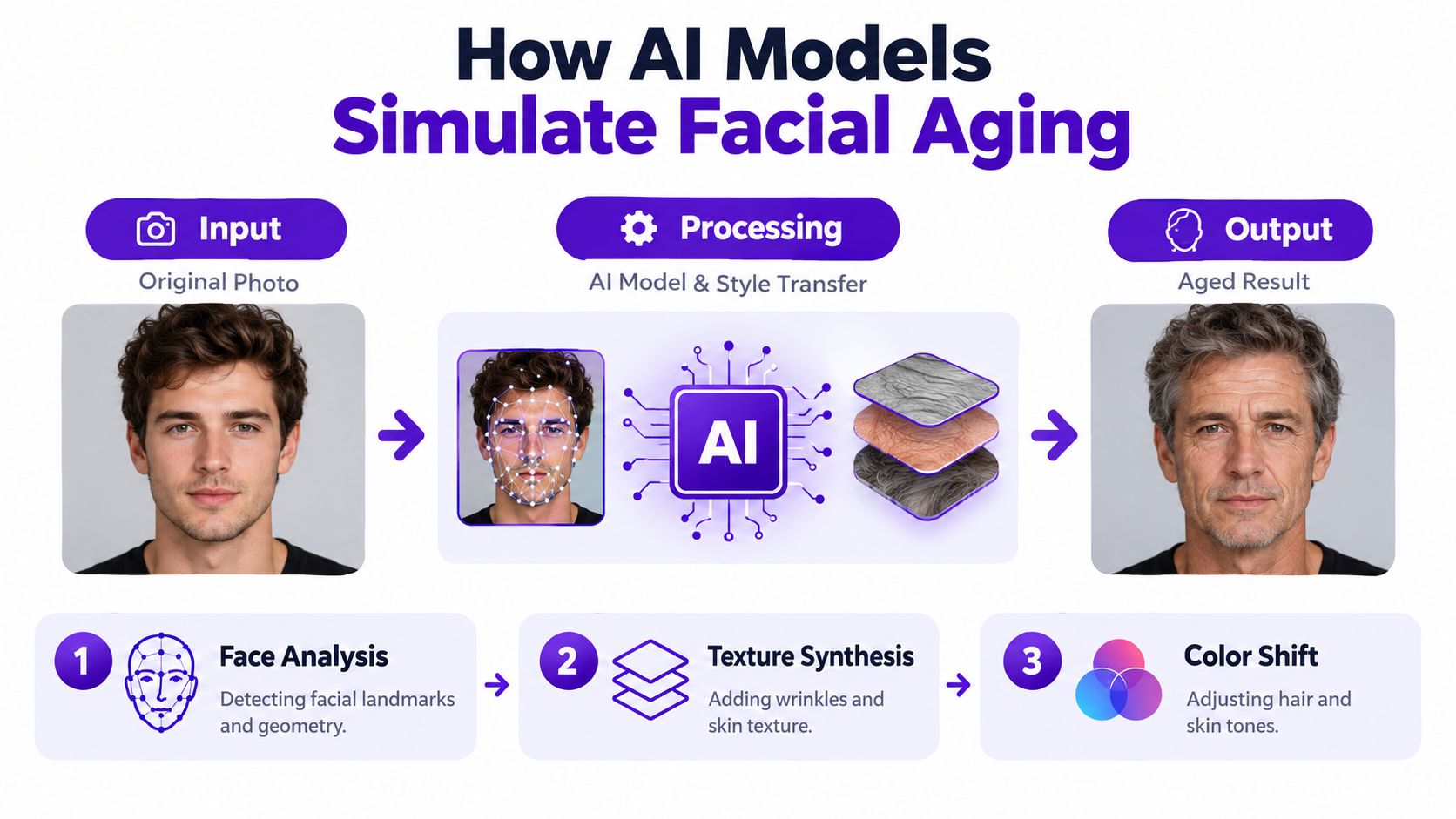
A useful way to understand the process is to separate identity analysis, structural transformation, and surface synthesis.
Identity analysis maps the source face. The system detects landmarks and estimates relationships between the eyes, nose, mouth, cheeks, chin, and jaw. This stage gives the model a geometric reference for what should remain recognizable.
Structural transformation changes facial form. Rather than treating the face as a flat canvas, the model estimates how regions may shift. Cheek volume can appear lower, the jawline can become less sharply defined, and the visible eye area can change. These regional adjustments carry more identity and age information than a blanket wrinkle overlay.
Surface synthesis completes the interpretation. The system adds skin texture, lines, changes in tone, and possible hair-color shifts. Surface details matter, but they work best after the underlying geometry has been handled.
Deep-learning systems learn these relationships from face-aging datasets. A technical review identifies FG-NET as a standard benchmark with 1,002 images from 82 subjects, while a progressive face-aging GAN paper describes MORPH as a popular benchmark containing 55,134 color face images captured in controlled conditions. Those datasets help models learn more stable relationships between age and appearance, although controlled photographs don't represent every selfie or portrait.
Training data with near-frontal poses, neutral expressions, moderate illumination, and simple backgrounds gives a model a cleaner foundation. A tilted face with heavy shadow, glasses, dramatic makeup, or an unusual expression gives the system less reliable evidence about the underlying geometry.
That's why one result may preserve a subject beautifully while another produces an exaggerated jawline, mismatched eyes, or wrinkles that ignore the direction of the face. The model isn't applying a single biological rule. It's synthesizing an interpretation from visual evidence, learned patterns, and the prompt or editing instructions you provide.
Practical rule: If the geometry looks wrong, adding more texture won't fix the portrait. Correct the pose, lighting, and facial structure first.
A strong workflow begins with a clean source image, not an elaborate prompt. Choose a portrait where the face is visible, the lighting is even, and the expression is natural. A forward-facing image gives the system more useful information about facial relationships than a profile hidden by shadow or hair.
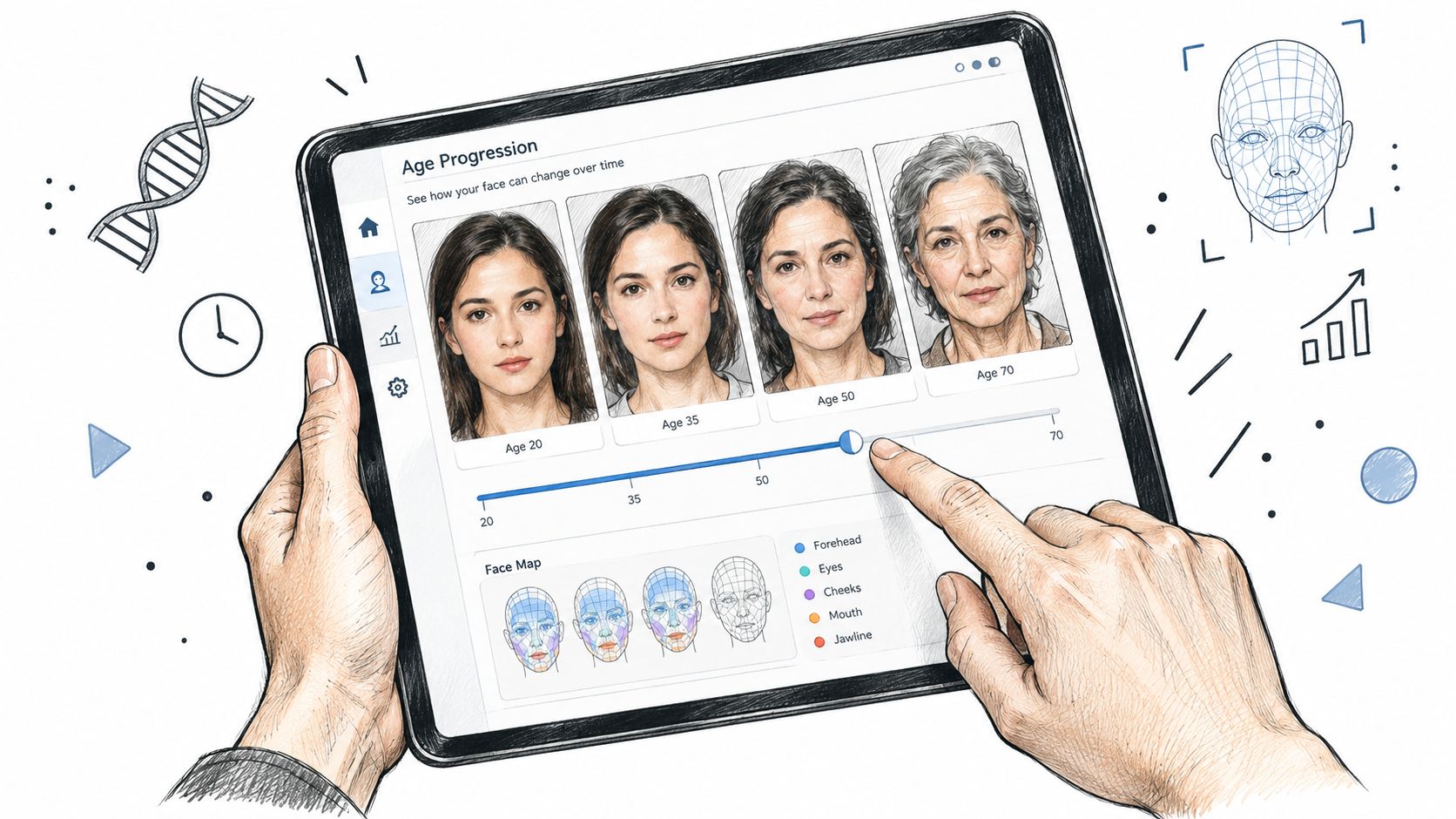
Start with the transformation you want, then describe the visual target. For example, a creator might write:
“Create a realistic age-progressed portrait of the same person, preserving facial identity, eye shape, nose structure, mouth proportions, and natural expression. Show believable changes in facial volume, skin texture, hair, and soft-tissue position. Keep the lighting, camera angle, and background consistent.”
This wording does two jobs. It identifies the desired age shift, while explicitly telling the system which features should remain stable. If you want a fictional character to look older after a difficult journey, add visual context such as weathered clothing, a changed hairstyle, or a more mature expression separately from the biological aging cues.
Avoid prompts that rely only on “old face,” “gray hair,” or “deep wrinkles.” Those phrases encourage surface exaggeration. They can produce a caricature rather than a coherent progression.
Generate an initial result, then inspect it at full size. Look at the eyes, jawline, nostrils, lips, ears, and hairline before judging the overall mood. A portrait can feel convincing at thumbnail size while revealing duplicated features or asymmetrical aging when enlarged.
Use an editing pass for one change at a time:
The Edit tool can support prompts such as “make me look 20 years older” or “show me as a teenager,” while an age progression workflow can create multiple versions from one selfie. Treat each version as a visual study rather than a definitive prediction. The most useful output may be the one that gives you a strong direction for a character sheet, cover concept, or social post.
A short demonstration can help you see how the editing interaction fits into a creator workflow:
If the face looks waxy, reduce descriptive language about flawless skin and ask for natural variation. If the jaw warps, return to a clearer source image and simplify the transformation. If the hair dominates the result, describe hair as a separate styling choice rather than the main marker of age.
A reliable working habit is to save the source, prompt, and chosen output together. That record lets you reproduce a character stage later, compare revisions, and explain that the image is AI-generated when you share it publicly.
Age progression becomes most useful when it serves a story. An indie author can keep one protagonist recognizable across a cover series, showing how the character changes as the narrative moves through different periods. Those portraits can inform casting references, promotional art, interior illustrations, and a visual bible for collaborators. Each image becomes a continuity marker, much like a costume or location that helps readers track time.
A tabletop RPG group can use the same approach to show what a character becomes after a long campaign. A young mage might return as a scarred archivist, while a rogue could reappear years later as a mentor with a different posture and a more restrained expression. These details make consequences, memory, and legacy visible without requiring a written history for every character.
For Etsy sellers and illustrators, age-progressed portraits can support personalized generational artwork when everyone depicted has given permission. A customer might request a fictional family across life stages, a keepsake for a character-driven story, or portraits that present an invented timeline. Creators testing several stages for one character can use an AI age filter tool to iterate across versions before selecting a direction. Strong products give buyers control over the narrative and describe the result as creative interpretation, not biological certainty.
The psychological effect deserves equal attention. A 2025 study on age-shifted photos found that age-progressed images encouraged participants to consider mental-health and lifestyle adaptations for aging, while age-regressed images drew attention to prevention and preserving independence. The findings are described in Monash University's record of the age-shifted photo study.
Future-self imagery can prompt reflection about health, relationships, work, or the person someone hopes to become. It can also produce anxiety when an image is framed as an unavoidable forecast. For a digital artist, the caption and presentation shape how viewers interpret the face.
A future face works best as a conversation starter, not a verdict.
Describe the portrait as an AI interpretation and invite discussion about the character's journey. Visible wrinkles, hair changes, or posture should not be presented as evidence of what a real person will look like. Personal projects also need space for the subject to reject the result. A compelling image remains responsible when it respects the person behind it.
The farther an image travels from its source moment, the more assumptions the system must make. A short progression can preserve much of the original facial structure while introducing moderate changes. A distant future requires the model to infer biological development, lifestyle, genetics, styling, expression, and image conditions that aren't fully present in the input.
External features make the problem harder. Haircuts, hair color, facial hair, glasses, makeup, jewelry, and clothing reflect personal choices rather than fixed anatomy. A model may treat those choices as evidence of age, even though the person could change them at any time.
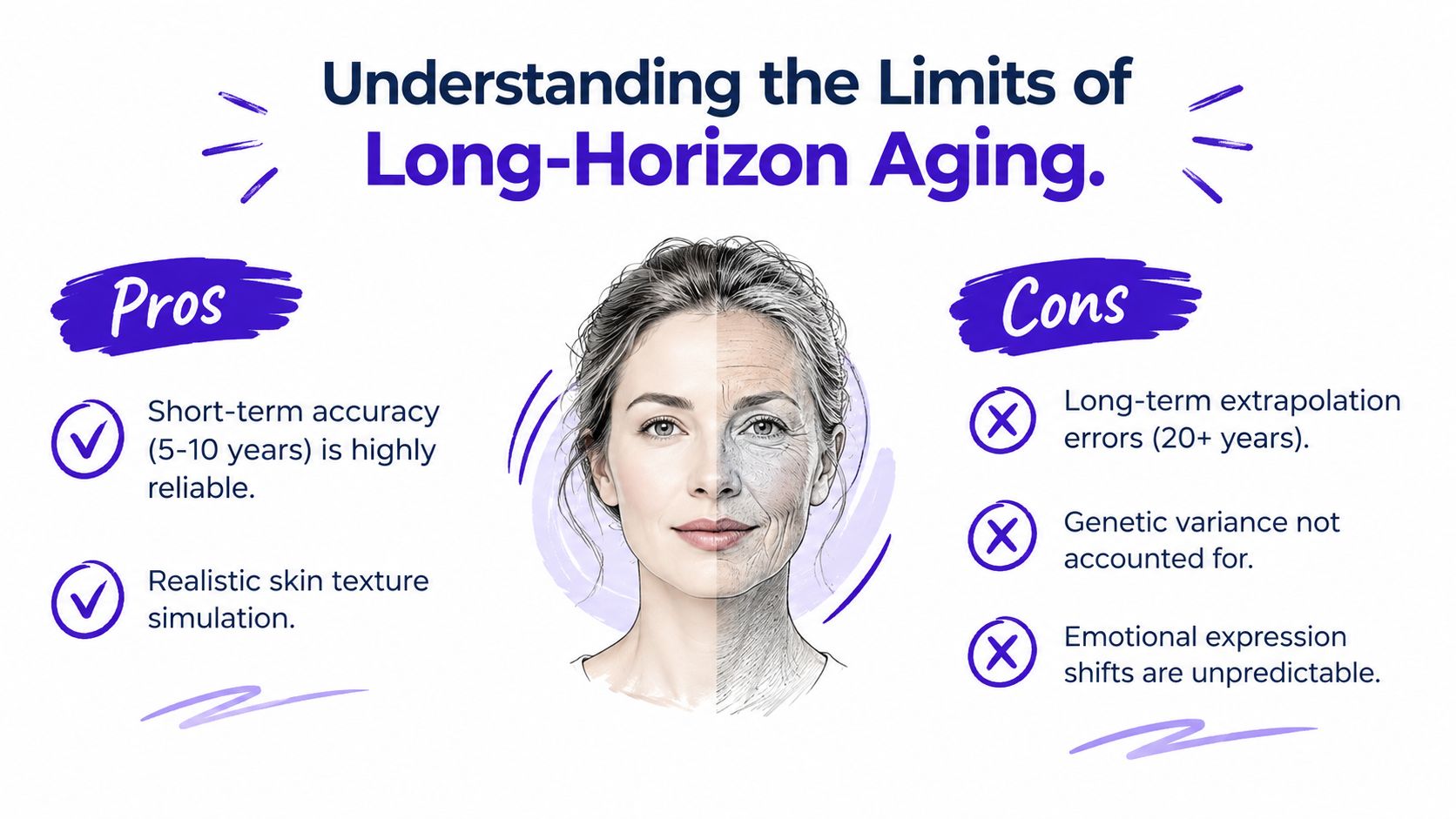
A 2026 study found that similarity between age-progressed and real photos was highest over shorter age ranges and when external features were concealed, suggesting that consumer coverage often overstates the reliability of long-horizon aging. The study on unreliable age-progressed images.%20When%20age%20progressed%20images%20are%20unreliable_The%20roles%20of%20external%20features%20and%20age%20range.pdf) is especially useful because it examines conditions that many quick tutorials leave out.
A forensic-art study also found that progressions were more accurate over shorter age ranges such as 5–12 and 12–20 than over 5–20, while undergraduate artists' progressions were rated similarly close to targets as those made by trained forensic artists. The undergraduate versions were also more likely to resemble description-matched foils, as shown in the study of student and forensic age progressions. In practical terms, visual plausibility and actual identity accuracy aren't the same thing.
Use a simple decision rule:
The limitation doesn't make the tool useless. It tells you how to frame the output. A long-horizon image can be excellent for mood boards, narrative planning, and conceptual art while remaining unsuitable as a factual claim about someone's future appearance.
The ethical boundary is simple: you control your own likeness, but you don't automatically control someone else's. Aging a fictional character is a normal creative act. Aging a living person without permission can become an unwanted transformation of their identity, particularly when the image is shared publicly or presented as authentic.
Consent should cover both creation and distribution. Someone might agree to see a private experiment but not want the image posted to a public account, used in an advertisement, printed on merchandise, or attached to a sensitive story. Ask separately about those uses, and keep the agreement clear.
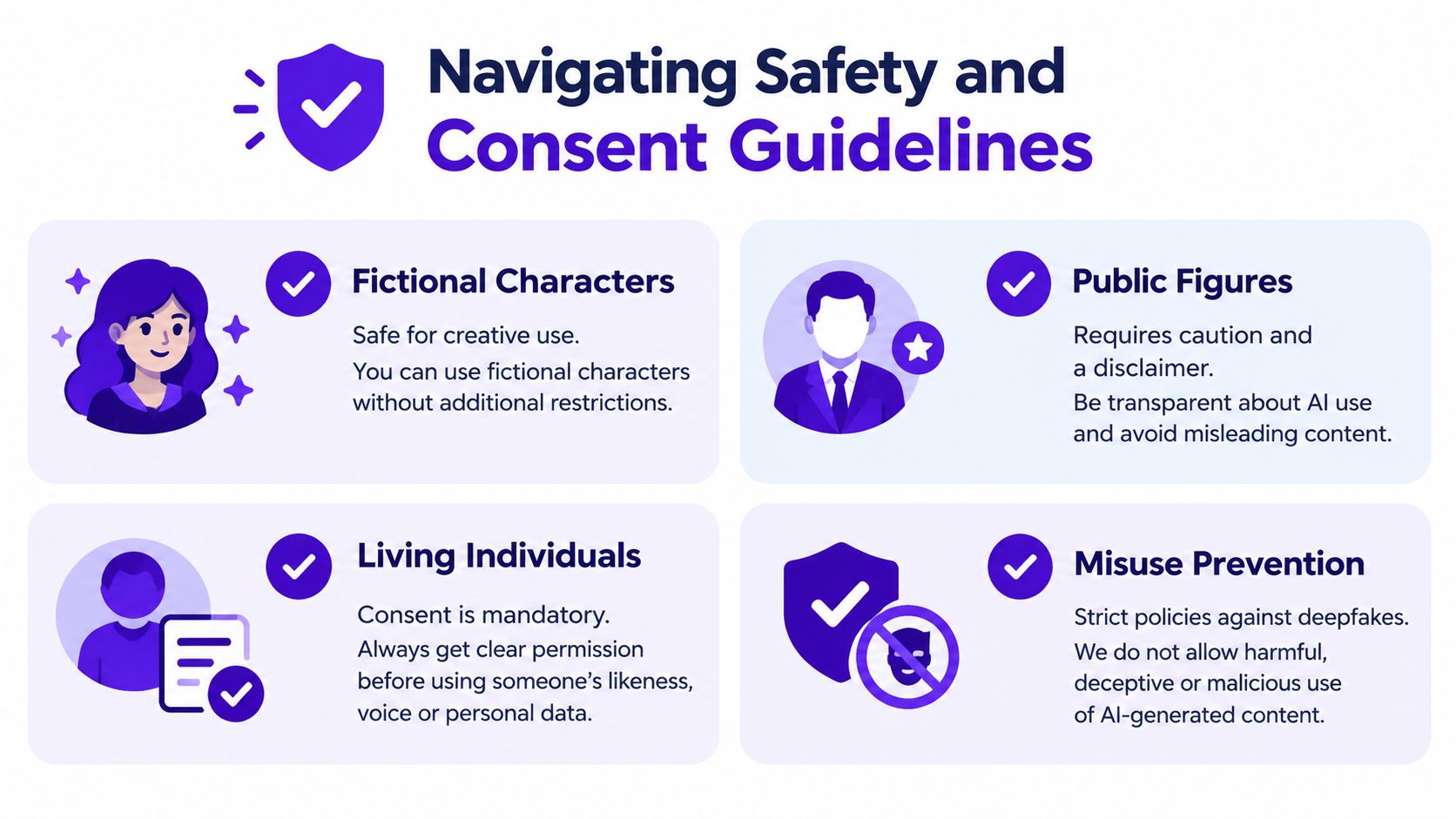
Fictional characters offer the widest creative freedom. You can explore an invented hero's entire life, test different timelines, and use the results in concept art without confusing the image with a real identity.
Public figures require caution. Public availability of a photograph doesn't grant unlimited permission to create or distribute manipulated imagery. Add a clear disclaimer when context could confuse viewers, and avoid presenting a generated progression as a genuine photograph or official record.
Living individuals need consent. This includes friends, relatives, customers, models, collaborators, and children. Don't upload a person's image because you have access to it. Their face remains personal information, and the emotional impact of seeing an unsolicited future version can be significant.
Misuse prevention must be active. Never use age progression to create misleading identity documents, impersonate someone, harass a target, or produce a non-consensual deepfake. Review the starryai content policy before creating or sharing sensitive material.
Missing-person work illustrates why context matters. The National Center for Missing & Exploited Children says age-progressed pictures approximate how a child may look over time, and its artists update a missing child's image every two years until age 18, then every five years after that because facial changes slow in adulthood. That professional process uses investigative context and family input, not just a casual upload.
Labeling helps, but it doesn't replace consent. Write “AI-generated age progression” when sharing the image, explain whether the subject approved it, and remove the post if the person withdraws permission. Responsible creators protect both the subject's dignity and the audience's ability to understand what they're seeing.
The best age-progressed photos combine three forms of judgment. Anatomical judgment keeps the transformation grounded in facial structure rather than surface decoration. Creative judgment decides what the character's future should communicate through posture, styling, expression, and context. Ethical judgment determines whether the image should be created, shared, or used commercially at all.
For digital artists, the workflow is iterative. Start with a clean source, preserve identity cues, and ask the system for regional facial changes instead of generic aging effects. Review the eyes, mouth, cheeks, jaw, and hairline at full size. Keep the original beside every revision, because visual continuity is easier to judge through comparison than memory.
For storytellers, uncertainty can become part of the craft. A future face doesn't need to claim certainty to carry emotional weight. It can represent a possible life, a character's imagined legacy, or the distance between who someone was and who they hope to become.
The technology will continue to evolve, but the creative principle is stable: use AI to open possibilities, not to disguise guesses as facts. Treat each output as a visual hypothesis, make its artificial origin clear, and give real people control over how their likeness is transformed.
starryai offers an AI image generator and creative tools for turning selfies, text prompts, and emojis into visual concepts, including age progression and regression workflows. Try it for a character study, future-self exploration, or time-spanning portrait sequence by visiting starryai, then keep your process transparent and your subjects' consent at the center.


.svg)